The dog watched parabolic meat with listless eyes and I realized my host mother was not a liar: (a) BuBu (sic) was, improbably but implacably, a vegetarian. Or at least a lapsed carnivore. One of four dogs, the others being
(b) Michi (sic, again), a porcine tan-piebald fat-roll-segmented grass-torpedo desperately, sadly masquerading as some variety of pug, lest his (doubtless subchordate, poor thing) true genus lend him brutal and swift excommunication,
(c) [name omitted], a low-slung unmnemogenic creature of the lapsed sheep-hound stripe but no literal stripe, only somewhat harassed I-am-brushed-perhaps-more-often-than-is-necessary lank dark blue-black parallel strands of wisp-tipped hair, and
(d?) [name omitted], a being that, as the hours seep past, I am beginning to suspect was created the moment my host brother (disinherited of his mother’s forthright nature, sorry bud) said We. Have. Four. Dogs., meaning, of course, something other than this, or perhaps meant to be closely followed by a caveat (“one is dead”) that was abandoned in a moment of internal fourteen-year-old knee-knocking, leaving our fourth item somewhat stranded, ontologically so, roaming only my headspace (no fences, rather unkempt), barking uncertainly at passing thoughts, worrying about neural fleas, possibly passing into aether at the fall of Damocles’ clarification, Damocles’ additional-polite-query-regarding-your-nonhuman-domestic-charges.
There are also three people and two cats.
Monday, July 19, 2010

Wednesday, June 30, 2010
Day One Hundred Sixty-four, in Which Reflections Are (Transparently) Metaphors
It is at the midpoint of the cline from opacity to transparency—variously occupied by lampshades, spun glass, cloudy water—that the retirement home’s dining-room partition flutters. Looking through it, I see my reflection sitting among the elderly of Vasvár, carefully sipping our soup. The soup, too, swirls weakly at this midpoint.
Lunch at the retirement home—commonly “the old house” or “the old man’s house”—is the midpoint of a routine that runs like this:
Wake at 8; avail myself of a faultless breakfast (whose niceties evidence conscientious preparation on the part of Mária, my magnificent host mother!); teach primary-school kids from 9 to 10 (in which the cockles of my heart are thawed via Hachi Pachi); teach early high-school kids from 10:30 to 11:30 (in which, while covering “likes” and “dislikes,” the class uniformly professes to like “Facebook” and “drinking” and dislike “learning”); lunch at the old man’s house; a free afternoon in which I forage for increasingly inventive ways of presenting the English language; a class of adult beginners from 5 to 6 (a small, highly motivated group); a class of advanced adults from 6:15 to 7:15 (conversation and correction in equal measure—a little like being on a first date with fifteen people at the same time); socializing with students from the advanced group; home for an inspired, sumptuous meal over which I prepare lessons plans for the next day; bed.
In the curtains and glass that separate me and my watery soup from the elderly and theirs sits a reflected figure just as real as the people beyond it. Every day between carrots and broth, I try to find a difference between them and me, thinking there must be some level of visual acuity at which we become distinct. I haven’t yet found it. It reminds me of the way my students mirror me, faithfully repeating words. They trust me like I trust my eyes. And, softly sipping slippery soup, I can’t help thinking that, here in Vasvár, the point of departure from reality to reflection must be extremely small and exceptionally well-hidden.
Lunch at the retirement home—commonly “the old house” or “the old man’s house”—is the midpoint of a routine that runs like this:
Wake at 8; avail myself of a faultless breakfast (whose niceties evidence conscientious preparation on the part of Mária, my magnificent host mother!); teach primary-school kids from 9 to 10 (in which the cockles of my heart are thawed via Hachi Pachi); teach early high-school kids from 10:30 to 11:30 (in which, while covering “likes” and “dislikes,” the class uniformly professes to like “Facebook” and “drinking” and dislike “learning”); lunch at the old man’s house; a free afternoon in which I forage for increasingly inventive ways of presenting the English language; a class of adult beginners from 5 to 6 (a small, highly motivated group); a class of advanced adults from 6:15 to 7:15 (conversation and correction in equal measure—a little like being on a first date with fifteen people at the same time); socializing with students from the advanced group; home for an inspired, sumptuous meal over which I prepare lessons plans for the next day; bed.
In the curtains and glass that separate me and my watery soup from the elderly and theirs sits a reflected figure just as real as the people beyond it. Every day between carrots and broth, I try to find a difference between them and me, thinking there must be some level of visual acuity at which we become distinct. I haven’t yet found it. It reminds me of the way my students mirror me, faithfully repeating words. They trust me like I trust my eyes. And, softly sipping slippery soup, I can’t help thinking that, here in Vasvár, the point of departure from reality to reflection must be extremely small and exceptionally well-hidden.
Sunday, June 20, 2010
Day One Hundred Fifty-four, in Which the Narrator Travels the Balkans
I had always thought "the rain fell in sheets" was poetic license. That was before Croatia. Three days later, my notebook has for us this smeary testament:
I remember the lightning, the way it made the sky purple in lines and flashes. The drainage system was a wreck.

A day earlier, I was enjoying the sun in Ljubljana, Slovenia. I still have some family there, but I wasn't nearly organized enough to look them up (should have). I had arrived the day before on a night train from Vienna (small, convoluted, bloated from an addiction to tourism). It was raining and dark, so I slept on the platform with a homeless guy. I woke up at seven. It was bright and clear. I explored. My hostel was excellent--a former prison-turned artists' atelier/creative space/gallery-turned hostel. It's called Hostel Celica. Look it up if you're ever in Ljubljana.
Slovenia was interesting in no small measure because of the undeniable echoes of its desire to Westernize.

Every country of the former Soviet Bloc has this, to an extent--a compulsion to present itself as as capital-W Western as possible. (Each country has its own goofy, selfconscious catchphrases you'll inevitably hear if you spend enough time talking to locals. Czech Republic: "Prague is West of Vienna" Slovenia: "We're not Slavic, we're 'Venetic'" Bosnia: "We hosted the Olympics once" &c.) It was interesting. A short example: I exited the train station and saw a modest plaster-and-brick house just outside the station. On the side, in neat grey letters, someone had painted in English: COMPUTER COMPANY. A decal of a computer adorned the window, as if to further demonstrate the point. There was a homework-on-the-fridge quality to it.

A further point of endearment: my surname being recognized and treated with an easy familiarity, the way "Johnson" or "Moore" would be in the US. It's a weird sort of privilege/convenience, something difficult to describe, and probably inexplicable--to some degree--to someone grew up with a name store clerks could always spell without help.

My final stop was Bosnia. When I bought a one-way ticket to Sarajevo, the Croatian ticket taker raised her eyebrows and repeated my destination sotto voce. Yes, I said.
The train was nearly empty. Cigarette ash was smeared on nearly every surface of my compartment. I fell asleep quickly. Shortly after three a.m., a uniformed man entered my compartment. He was a short, fat man in an ill-fitting uniform with Cyrillic lettering. I gave him my passport. He asked where I was from in the US. When I said Alaska, his face lit up. He pushed a hand into his chest (as though pledging to some unseen entity) and told me visiting it was his dream. He said it not like it was tangible dream, but more in the manner I would describe wishing to visit the moon: something tremendous not only for its own sake, but also for the elegant impossibility of its realization. I told him it was beautiful there and he repeated it as though fingering a rosary: "Yes, it is beautiful there. It is beautiful there. It is beautiful." He corrected himself after a few repetitions: "She is beautiful."
The city itself was bullet-riddled and fascinating. The skyline is stippled with minarets. Graveyards dot the hillsides. Most of the death dates fall in the mid-90s.


I went to the old Olympic stadium and visited the museum. I was the third visitor in the month of June.
There's an identifiable manner in which a person who has experienced war in his or her native country carries this experience. I talked to some Bosnian students at one point. They were about my age which means they were, what, eight or so when the war ended? At one point, a girl named Manuela mentioned laughingly that we'd all be dead in 2013 anyway. Thinking she was referencing the Mayan calendar, I asked if she meant 2012. No, she said, there's going to be war as Europe has never known in 2013. Someone asked her what she meant. She shrugged and said she'd heard it from a man on television. He said the living would envy the dead, she said.
Most people I've encountered who lend credence to apocalyptic theory do it with a sort of earnest acceptance of or even enthusiasm for its fantastic quality, the unreal nature of things like "the end of time" and death and destruction on a massive scale. Manuela regarded this future war in an entirely different way. She talked about it like the weather. She could have been talking about whether traffic would be bad next Monday.
I realized, sitting there, that certain things were real for her that would never be real for me.
Zagreb, Croatia -- under the meager rainshadow of the train platform. across the tracks some sort of monstrous communist-era building has mounted on it two floodlights that spray parallel arcs of twinkling white-lit raindrops [indecipherable] riding the wind in surges. lightning made purple by some atmospheric confluence veins the sky. the platform shelter is riddled with network of cracks and gaps through which rainwater mists or drips or pours, depending on the character of the rent. the wind is blowing [indecipherable]
I remember the lightning, the way it made the sky purple in lines and flashes. The drainage system was a wreck.

A day earlier, I was enjoying the sun in Ljubljana, Slovenia. I still have some family there, but I wasn't nearly organized enough to look them up (should have). I had arrived the day before on a night train from Vienna (small, convoluted, bloated from an addiction to tourism). It was raining and dark, so I slept on the platform with a homeless guy. I woke up at seven. It was bright and clear. I explored. My hostel was excellent--a former prison-turned artists' atelier/creative space/gallery-turned hostel. It's called Hostel Celica. Look it up if you're ever in Ljubljana.
Slovenia was interesting in no small measure because of the undeniable echoes of its desire to Westernize.

Every country of the former Soviet Bloc has this, to an extent--a compulsion to present itself as as capital-W Western as possible. (Each country has its own goofy, selfconscious catchphrases you'll inevitably hear if you spend enough time talking to locals. Czech Republic: "Prague is West of Vienna" Slovenia: "We're not Slavic, we're 'Venetic'" Bosnia: "We hosted the Olympics once" &c.) It was interesting. A short example: I exited the train station and saw a modest plaster-and-brick house just outside the station. On the side, in neat grey letters, someone had painted in English: COMPUTER COMPANY. A decal of a computer adorned the window, as if to further demonstrate the point. There was a homework-on-the-fridge quality to it.

A further point of endearment: my surname being recognized and treated with an easy familiarity, the way "Johnson" or "Moore" would be in the US. It's a weird sort of privilege/convenience, something difficult to describe, and probably inexplicable--to some degree--to someone grew up with a name store clerks could always spell without help.

My final stop was Bosnia. When I bought a one-way ticket to Sarajevo, the Croatian ticket taker raised her eyebrows and repeated my destination sotto voce. Yes, I said.
The train was nearly empty. Cigarette ash was smeared on nearly every surface of my compartment. I fell asleep quickly. Shortly after three a.m., a uniformed man entered my compartment. He was a short, fat man in an ill-fitting uniform with Cyrillic lettering. I gave him my passport. He asked where I was from in the US. When I said Alaska, his face lit up. He pushed a hand into his chest (as though pledging to some unseen entity) and told me visiting it was his dream. He said it not like it was tangible dream, but more in the manner I would describe wishing to visit the moon: something tremendous not only for its own sake, but also for the elegant impossibility of its realization. I told him it was beautiful there and he repeated it as though fingering a rosary: "Yes, it is beautiful there. It is beautiful there. It is beautiful." He corrected himself after a few repetitions: "She is beautiful."
The city itself was bullet-riddled and fascinating. The skyline is stippled with minarets. Graveyards dot the hillsides. Most of the death dates fall in the mid-90s.


I went to the old Olympic stadium and visited the museum. I was the third visitor in the month of June.
There's an identifiable manner in which a person who has experienced war in his or her native country carries this experience. I talked to some Bosnian students at one point. They were about my age which means they were, what, eight or so when the war ended? At one point, a girl named Manuela mentioned laughingly that we'd all be dead in 2013 anyway. Thinking she was referencing the Mayan calendar, I asked if she meant 2012. No, she said, there's going to be war as Europe has never known in 2013. Someone asked her what she meant. She shrugged and said she'd heard it from a man on television. He said the living would envy the dead, she said.
Most people I've encountered who lend credence to apocalyptic theory do it with a sort of earnest acceptance of or even enthusiasm for its fantastic quality, the unreal nature of things like "the end of time" and death and destruction on a massive scale. Manuela regarded this future war in an entirely different way. She talked about it like the weather. She could have been talking about whether traffic would be bad next Monday.
I realized, sitting there, that certain things were real for her that would never be real for me.
Thursday, May 27, 2010
Day One Hundred Thirty, in Which the Narrator Attains a Room of One's Own
I've been in the new apartment a week.
It is a clean, well-lighted place and I have been productive in it, averaging somewhere north of 1300 words per diem.
The neighborhood is fantastic. I'm reminded most strongly of Brooklyn's Park Slope, with perhaps less affluence (manifest in brownstones &c) and more youth, which sounds like Williamsburg 'should sound,' maybe, if neighborhoods have prerecorded sonic ambiances that're somehow not impossibly protean, but it's not really the same wavelength, I promise. It's just cool, on its own, over here.
Also I found out where I'm going to be teaching English in July and August--maps ahoy.
The first town is in Hungary and is called Vasvár.
View Larger Map
The second is in Slovakia and is called Trhová Hradská.
View Larger Map
EXCITEMENT.
It is a clean, well-lighted place and I have been productive in it, averaging somewhere north of 1300 words per diem.
The neighborhood is fantastic. I'm reminded most strongly of Brooklyn's Park Slope, with perhaps less affluence (manifest in brownstones &c) and more youth, which sounds like Williamsburg 'should sound,' maybe, if neighborhoods have prerecorded sonic ambiances that're somehow not impossibly protean, but it's not really the same wavelength, I promise. It's just cool, on its own, over here.
Also I found out where I'm going to be teaching English in July and August--maps ahoy.
The first town is in Hungary and is called Vasvár.
View Larger Map
The second is in Slovakia and is called Trhová Hradská.
View Larger Map
EXCITEMENT.
Tuesday, May 18, 2010
Day One Hundred Twenty-one, in Which the Narrator Transitions
Everyone is gone.
The program is over, and the saner of its number have left, flying west over the Atlantic, deplaning in Rhode Island, New Jersey, New York (city & upstate), Georgia, Colorado, Washington, California. Other places, too: as many as there are people.
I am here, still. I ride the tired tram routes (hi, 17) we made sweaty arteries of youth and Americanism that sometimes embarrassed us, yeah, they did. Sometimes. Anyway. They're dry now, just sere veins of Czechs who somehow look more foreign to me than they did in January.
I'll stay here for another month, reading and writing (maybe in this space!), and then I'll travel to Slovakia and Hungary to teach English. I will return to Los Angeles in August, possibly on a cargo ship.
Tomorrow I am moving to an apartment in a different part of Prague, a little rougher, maybe, but 'cheap' and 'different,' a combination I chase almost as much as 'smart' and 'into Virgina Woolf.' It's on--I just turned my head right, looking for the map of Prague that's hung there all semester, but it's packed--Slezská Street, which is sort of on the border between the districts of Žižkov (used to be rough, gentrifying) and Vinohrady (young, gay, haunted by starving literati and other walking tropes). East Prague.
View Larger Map
I'm sitting here, reading Too Loud a Solitude (Hrabal, 1976). I haven't read it since I was eighteen. People ask me why I come to Prague and if I don't make a joke (what this is Prague goddamn that hot-air balloon conductor, etc.) I say something about how I Was 'Really Into' Czech Literature a Few Years Ago and So That Piqued My Interest How About You? The book that I have in mind when I say this is Too Loud a Solitude.
It's this shimmering slim slice of literary magic that 'brought' me here, if anything did, which I sort doubt that anything did, but. It is a rarity in that it's just as good as the first time I read it--and so rich, so newly textured by four months in Prague, the only city that could have produced this book, bleeding its own oracular mystery out in ink.
So, like any good protagonist, I've reached back into the prologue and drawn out a neat, golden thread of continuity and sewn everything up, right at the end.
I like that. It's a nice way of ending a story. A very nice way.
The program is over, and the saner of its number have left, flying west over the Atlantic, deplaning in Rhode Island, New Jersey, New York (city & upstate), Georgia, Colorado, Washington, California. Other places, too: as many as there are people.
I am here, still. I ride the tired tram routes (hi, 17) we made sweaty arteries of youth and Americanism that sometimes embarrassed us, yeah, they did. Sometimes. Anyway. They're dry now, just sere veins of Czechs who somehow look more foreign to me than they did in January.
I'll stay here for another month, reading and writing (maybe in this space!), and then I'll travel to Slovakia and Hungary to teach English. I will return to Los Angeles in August, possibly on a cargo ship.
Tomorrow I am moving to an apartment in a different part of Prague, a little rougher, maybe, but 'cheap' and 'different,' a combination I chase almost as much as 'smart' and 'into Virgina Woolf.' It's on--I just turned my head right, looking for the map of Prague that's hung there all semester, but it's packed--Slezská Street, which is sort of on the border between the districts of Žižkov (used to be rough, gentrifying) and Vinohrady (young, gay, haunted by starving literati and other walking tropes). East Prague.
View Larger Map
I'm sitting here, reading Too Loud a Solitude (Hrabal, 1976). I haven't read it since I was eighteen. People ask me why I come to Prague and if I don't make a joke (what this is Prague goddamn that hot-air balloon conductor, etc.) I say something about how I Was 'Really Into' Czech Literature a Few Years Ago and So That Piqued My Interest How About You? The book that I have in mind when I say this is Too Loud a Solitude.
It's this shimmering slim slice of literary magic that 'brought' me here, if anything did, which I sort doubt that anything did, but. It is a rarity in that it's just as good as the first time I read it--and so rich, so newly textured by four months in Prague, the only city that could have produced this book, bleeding its own oracular mystery out in ink.
So, like any good protagonist, I've reached back into the prologue and drawn out a neat, golden thread of continuity and sewn everything up, right at the end.
I like that. It's a nice way of ending a story. A very nice way.
Monday, May 10, 2010
Day One Hundred Thirteen, in Which Things (Soon) Fall Apart
I've been part of social groups a hair away from dissolution before: the end of elementary school; the end of summer camp; the end of high school; a friend group (or five) held together by a set of relationships become newly tenuous.
But: I've never been in social group so aware of its own impending disintegration. We're no longer sufficiently callow, maybe. So, this, this: this fairly homogeneous group of 94 (give, take) students from 30 or so different colleges. Our social graph has a strange destiny: mesa. A sharp uptick four months ago, a plateau in which the only undulations are slight, those of formulaic social recalibration, and then a searing plunge, hardly tempered by faint promises of reconciliation and quixotic Facebooking. The precipice doesn't come until next week, but there's a palpable sensation of cessation, punctuated like the tick, tick, tick of an ascending roller-coaster. It slips beneath the pregamed dancing and smeary conversation the way dark matter pirouettes behind regular matter, changing the way galaxies rotate and bending light from distant stars. Or, to shift cosmological metaphors, background radiation: It's not something anyone thinks or talks about on the daily, but turn your rabbit ears between the channels and try to tell me there's no static. I imagine it sort of like a group of houseguests who can see that, yeah, the house is on fire, sure, but the drapes haven't even caught yet so here's another Gaga track. That's not to suggest we should all run out of the house, sooty and hysterical, and stand on the lawn and watch it burn and go home and listen to The Shins: I'm not Paul Revere, here. To go out in my tricorne and cry "THE END IS COMING" is about as prophetic as shouting "THIS IS THE OLDEST WE'VE EVER BEEN" or "IN FOUR YEARS, A MAJORITY OF US WILL BE MARRIED."
We know. Don't remind us. The carpet's barely smoldering, anyway.
But: I've never been in social group so aware of its own impending disintegration. We're no longer sufficiently callow, maybe. So, this, this: this fairly homogeneous group of 94 (give, take) students from 30 or so different colleges. Our social graph has a strange destiny: mesa. A sharp uptick four months ago, a plateau in which the only undulations are slight, those of formulaic social recalibration, and then a searing plunge, hardly tempered by faint promises of reconciliation and quixotic Facebooking. The precipice doesn't come until next week, but there's a palpable sensation of cessation, punctuated like the tick, tick, tick of an ascending roller-coaster. It slips beneath the pregamed dancing and smeary conversation the way dark matter pirouettes behind regular matter, changing the way galaxies rotate and bending light from distant stars. Or, to shift cosmological metaphors, background radiation: It's not something anyone thinks or talks about on the daily, but turn your rabbit ears between the channels and try to tell me there's no static. I imagine it sort of like a group of houseguests who can see that, yeah, the house is on fire, sure, but the drapes haven't even caught yet so here's another Gaga track. That's not to suggest we should all run out of the house, sooty and hysterical, and stand on the lawn and watch it burn and go home and listen to The Shins: I'm not Paul Revere, here. To go out in my tricorne and cry "THE END IS COMING" is about as prophetic as shouting "THIS IS THE OLDEST WE'VE EVER BEEN" or "IN FOUR YEARS, A MAJORITY OF US WILL BE MARRIED."
We know. Don't remind us. The carpet's barely smoldering, anyway.
Thursday, April 22, 2010
Day Ninety-five, in Which Prague has Sprung
Sometime in January, was it? I posted this picture of the view from my window:

The same view has since appreciated such that it demands our appreciation:

Moc hezký.

The same view has since appreciated such that it demands our appreciation:

Moc hezký.
Sunday, April 11, 2010
Day Eighty-four, in Which the Narrator is Irradiated
"This is a unique experience; I don't think they usually let people into uranium mines."
"For a pretty good reason, right?"
"Well, they aired it out yesterday."
"Aired it out? Can you do that with radiation? Just air it out?"
"I'm not sure."
"I really don't think you can."
And so we descended into the invisibly pulsing mines of Jáchymov. Map:

The world has Jáchymov to 'thank' for about five things:
So: sort of a mixed bag. That's a metaphor I try to stay away from, because it's tired and pallid, but I also try to stay away from uranium, so. Also, I think if we take the metaphorical vehicle as a burlap sack stuffed with uranium ore, fine silverware, and an ICBM, it can't help but illuminate the point.
Before we were standing in the wet, narrow shaft listening to the (divinely affecting and directly told--imagine Vonnegut's sensibility for sincerity in the face of apocalyptic horror) stories of a former political prisoner made to work in the mines, we visited the camp at which the ore was processed. It was also staffed (word choice) by political prisoners. The thematic and visual center of the camp was Věž smrti--the tower of death. In it, prisoners were tasked with grinding down high-quality uranium for shipment to the USSR. The air was continually saturated with impossibly poisonous uranium dust. A short time in the tower was more than enough to forever conclude one's prospects for leading a healthy life; scoliosis and cancer filtered out of the tower in neverending waves, borne by the workers' frail bodies.
Afterward, we went and saw a castle on a cliff.
"For a pretty good reason, right?"
"Well, they aired it out yesterday."
"Aired it out? Can you do that with radiation? Just air it out?"
"I'm not sure."
"I really don't think you can."
And so we descended into the invisibly pulsing mines of Jáchymov. Map:

The world has Jáchymov to 'thank' for about five things:
- The word dollar, which came from thaler, which came from a hip twist on Jáchymov;
- eleven tons of silver, give or take a few million dollars' worth;
- the element radium, which Marie Curie discovered here before it killed her and claimed its rightful place as the most ungrateful of the alkaline earth metals;
- a couple hundred Soviet nuclear weapons; and
- this blog post.
So: sort of a mixed bag. That's a metaphor I try to stay away from, because it's tired and pallid, but I also try to stay away from uranium, so. Also, I think if we take the metaphorical vehicle as a burlap sack stuffed with uranium ore, fine silverware, and an ICBM, it can't help but illuminate the point.
Before we were standing in the wet, narrow shaft listening to the (divinely affecting and directly told--imagine Vonnegut's sensibility for sincerity in the face of apocalyptic horror) stories of a former political prisoner made to work in the mines, we visited the camp at which the ore was processed. It was also staffed (word choice) by political prisoners. The thematic and visual center of the camp was Věž smrti--the tower of death. In it, prisoners were tasked with grinding down high-quality uranium for shipment to the USSR. The air was continually saturated with impossibly poisonous uranium dust. A short time in the tower was more than enough to forever conclude one's prospects for leading a healthy life; scoliosis and cancer filtered out of the tower in neverending waves, borne by the workers' frail bodies.
Afterward, we went and saw a castle on a cliff.
Saturday, April 3, 2010
Day Seventy-six, in Which Kraków Abides
This past weekend, I embarked on a journey both dense and expansive enough that it would be a criminal omission to not render it here. It could be passably described as 44 interlocking hours of ecstasies and miseries.
Thursday, 8 a.m. -- Wake blearily. Attend Czech.
Thursday, noon -- Better-than-expected lunch of tuna salad and milk. Study theories of totalitarianism.
Thursday, 5 p.m. -- The battle of the totalitarianism midterm is joined. Rivulets of ink spilled instead of blood.
Thursday, shortly before midnight -- Across Prague. Board a bus bound for Kraków.
Friday, 12 to 6 a.m. -- Bus ride:
View Larger Map
Friday, 8 a.m. -- Auschwitz, camp I. Imbued with a dense sort of terror. Buttoned-up horror.


Friday, 10 a.m. -- Auschwitz-Birkenau, camp II. A sprawling, fathomless abomination.


Friday, 2 p.m. -- A tour of Kraków's undersized but teeming city center. Saw Oskar Schindler's factory. Took forgettable pictures.

Friday, 8 p.m. -- Dinner and nightlife commence. 170,000 of Kraków's 750,000 inhabitants are students. Revelry here glistens with a youthful sheen and is well above average for Eastern Europe. The language, when spoken, is similar to Czech. Though far from intelligible, it occasionally lent itself to comprehension.

Saturday, early morning -- My 44-hour day ends as it began: blearily.
Sorry this is a touch terse, but I'm moderately compressed by time (orlackthereof).
I am also without the descriptive power to do Auschwitz justice, or even cast the faintest shadow of a meaningful description here.
Thursday, 8 a.m. -- Wake blearily. Attend Czech.
Thursday, noon -- Better-than-expected lunch of tuna salad and milk. Study theories of totalitarianism.
Thursday, 5 p.m. -- The battle of the totalitarianism midterm is joined. Rivulets of ink spilled instead of blood.
Thursday, shortly before midnight -- Across Prague. Board a bus bound for Kraków.
Friday, 12 to 6 a.m. -- Bus ride:
View Larger Map
Friday, 8 a.m. -- Auschwitz, camp I. Imbued with a dense sort of terror. Buttoned-up horror.


Friday, 10 a.m. -- Auschwitz-Birkenau, camp II. A sprawling, fathomless abomination.


Friday, 2 p.m. -- A tour of Kraków's undersized but teeming city center. Saw Oskar Schindler's factory. Took forgettable pictures.

Friday, 8 p.m. -- Dinner and nightlife commence. 170,000 of Kraków's 750,000 inhabitants are students. Revelry here glistens with a youthful sheen and is well above average for Eastern Europe. The language, when spoken, is similar to Czech. Though far from intelligible, it occasionally lent itself to comprehension.

Saturday, early morning -- My 44-hour day ends as it began: blearily.
Sorry this is a touch terse, but I'm moderately compressed by time (orlackthereof).
I am also without the descriptive power to do Auschwitz justice, or even cast the faintest shadow of a meaningful description here.
Sunday, February 28, 2010
Day Forty-one, in Which the Háje Paneláky Are Visited
About sixty years ago, the Czechoslovak government's urban planners came together in what I imagine to be a cacophonous goulash of adderall and ideology and produced the sort of idea that normally comes from, well, communist urban planners. This idea was to make as many citizens as humanly possible live in as few structures as possible. For, you know, solidarity. This led to the panelák, a dense, concrete monolith teeming with inhabitants crammed between its paper-thin walls. Built in monotonous clusters, the resultant panelák communities often saw tens of thousands of people living on one block. One of the most notorious panelák communities is Háje, an insular grouping of paneláky clinging to the gaunt outskirts of Prague. It lies at the very end of Prague's longest metro line, which is where I, unassumingly dressed, disembarked earlier today.
For your spatial frame of reference:
View Larger Map
Ascending from the metro, I found myself in a courtyard bound by a thousand balconies. Paneláky rose on all sides. Defeated-looking grass clung to life among patches of brown snow and black dirt. Cigarette butts populated the ground at a rate of thirty per square meter--assuming a courtyard of 40x55m and accurate observation on my part, 66,000 in this courtyard alone.

At first, I was a shade underwhelmed. However, as each monstrous panelák I passed dutifully revealed another concrete expanse behind it, I began to feel the true enormity of this place. I wandered aimlessly through a world punctuated at every instance by concreted towers ripe with humanity: catenary clotheslines sagging with tablecloths, paisley skirts, and children's stained denim; cockeyed satellite dishes supported by erector-set construction; lawn chars perched on cinder blocks and mattresses; chainsmokers nestled in 14th-story roosts; soccer balls, shriveled and cracked. These human obelisks extended in every direction, a raw sprawl.

As I ambled through this endlessly drab but indisputably alive world, a rising sense of unreality took me. I began to internalize the unbending repetition, mechanically taking photographs and jotting notes. I don't know how long I meandered; time became gossamer and slick, slipped its clothespins.

Though I had arrived in mid-afternoon, I found the sun just moments from setting. Quoting from my notes at the time:

As I wound an uncertain way back through dusky streets, my feeling of unreality began to distill into something new. At first, I couldn't qualify the resultant feeling. Eventually, however, I was able to put it on paper:
For your spatial frame of reference:
View Larger Map
Ascending from the metro, I found myself in a courtyard bound by a thousand balconies. Paneláky rose on all sides. Defeated-looking grass clung to life among patches of brown snow and black dirt. Cigarette butts populated the ground at a rate of thirty per square meter--assuming a courtyard of 40x55m and accurate observation on my part, 66,000 in this courtyard alone.

At first, I was a shade underwhelmed. However, as each monstrous panelák I passed dutifully revealed another concrete expanse behind it, I began to feel the true enormity of this place. I wandered aimlessly through a world punctuated at every instance by concreted towers ripe with humanity: catenary clotheslines sagging with tablecloths, paisley skirts, and children's stained denim; cockeyed satellite dishes supported by erector-set construction; lawn chars perched on cinder blocks and mattresses; chainsmokers nestled in 14th-story roosts; soccer balls, shriveled and cracked. These human obelisks extended in every direction, a raw sprawl.

As I ambled through this endlessly drab but indisputably alive world, a rising sense of unreality took me. I began to internalize the unbending repetition, mechanically taking photographs and jotting notes. I don't know how long I meandered; time became gossamer and slick, slipped its clothespins.

Though I had arrived in mid-afternoon, I found the sun just moments from setting. Quoting from my notes at the time:
walking the grubby streets, light reflected from the windows is unexpectedly sandia [watermelon-colored]. when did the sun start setting? I'm seized by the irrational presentiment that when darkness falls here, the exits close and this bubble becomes isolated not only geographically, but breaks loose temporally. the inexplicable sensation of being trapped here when night falls, stuck in an anachronistic communist dream forever.

As I wound an uncertain way back through dusky streets, my feeling of unreality began to distill into something new. At first, I couldn't qualify the resultant feeling. Eventually, however, I was able to put it on paper:
here is the place in which the 20th-cent. fascination with modernity has been refined and brought to bear, poured into this place like a leaden glaze. everything drips with it, slick and sodden.
I have never felt more anonymous.
Sunday, February 21, 2010
Day Thirty-four, in Which the Narrator Travels to the Sudetenland
Earlier today, I found myself in the windswept northwest reaches of the Czech Republic, near the Czech-German border. I was visiting the town of Terezín and what is left of Lidice, which can no longer be called a town. Both are located in the Sudetenland, a patchwork of border regions that hem the edges of the Czech Republic. They are stitched together by the sinewy thread of a shared ethnic German population. In the lead-up to WWII, the Sudetenland was infamously ceded to Nazi Germany by Neville Chamberlain & Co. in an effete attempt to forestall Hitler's towering barbarity. After the war, a majority of the ethnic Germans living there were expelled by the Czechs as a reprisal for the crimes of the Nazis. To this day, debate lingers among historian's swarthy minds as to whether or not this was an... overreaction. (Around a million Germans died as a result of post-WWII reprisals across Europe.)
Lidice, once a thriving, provincial hamlet, no longer exists. This is where it used to be:
View Larger Map
After two Czech paratroopers assassinated Reinhard Heydrich, Reichsprotektor of Bohemia and Moravia, an apoplectic Hitler carried off several responses of increasing lunacy. Fairly far along this arc of madness lies the erasure of Lidice. On June 10, 1942, German soldiers entered the town and shot, in groups of ten, every man over the age of 15. The women and children were shipped to concentration camps where nearly all of them died. Three Lidice families who happened to be out of town that day were tracked down and shot, and every structure in the town was blown out of the ground. Even the cemetery was dug up and bulldozed; the town in its entirety was physically eradicated. Today, a statue of the children of Lidice (nearly all of whom were gassed upon their arrival at Chelmno extermination camp) looks over a field that contains nothing but snow and a few stone monuments.

After Lidice, I traveled further northwest, to Terezín. This is where Terezín is:
View Larger Map
Originally built in the 18th century as a military fortress by the Hapsburg Monarchy, Terezín was emptied of its original inhabitants in 1940 and converted into a Jewish ghetto. Its natural defenses were inverted for the purposes of keeping people in, and the town, formerly of 4,000 inhabitants, swelled with the weight of over 70,000. Terezín served as a major point of amalgamation for the Jewry of Eastern Europe. It was thousands' final checkpoint before Auschwitz. The consolidation, with Terezín as the locus:
 Fed by so many bleak tributaries, Terezín's misery became denser and denser, finally collapsing into a singularity of desolation. The inhabitants of the ghetto were crammed into attics and cellars, given next to no food, made to work 18 hours a day in freezing conditions, and beaten mercilessly. After only a few days, a majority of the population became severely diarrhetic. Next to no latrines or hygienic facilities were available in the ghetto, which soon became miry with waste and death.

During the first few days, death rates were low enough that bodies could still be buried, and funerals performed. However, as death rates climbed exponentially (literally), this quickly became impossible. The Nazis began work on a four-oven crematorium, which was completed in the fall of 1942. It ran continuously until the end of the war. Over 33,000 people died in the ghetto itself, and another 88,000 were sent to find certain death in liquidation camps to the east.

In this turbid course of events, a young girl of nascent artistic talent was separated from her father, who was placed in a different section of the ghetto. Through a fortuitous contact, she managed to smuggle a picture to him. She had drawn a snowman. On the back, she had written that she loved him. A few days later, the drawing was smuggled back to her. Her father had written that he loved her and that she ought not to draw snowmen. Instead, he had written: draw what you see. So, she drew one of the jagged, raw scenes so common in the ghetto and smuggled it to her father. It was returned to her blank, along the news that he had been put on a train car to Auschwitz a few days prior. His last words to her had been "draw what you see." So, she did. From then until the end of the war, she drew hundreds of bleak, realistic, and indelibly beautiful pictures of everyday life in the ghetto. Today, this body of work paints perhaps the most vibrant portrait of the Terezín ghetto we have:

While she drew away the years, a teacher on the other side of the ghetto led his gaunt students to a large, stately willow tree near the crematorium. He told them that after WWI, it had taken over five years for the members of his family to reunite with one another, scattered as they were by the war. He made his charges promise that when this had ended, they would return to the willow and find one another. Those who survived kept that promise, and today the scarred trunk of the Meeting Tree still stands in Terezín, just behind the crematorium, where it is visited by the descendants of those who reunited beneath its arched branches.

Terezín was liberated May 9, 1945, by the Soviet Army. Today, it is once again a small town of about 3,100 inhabitants.

Lidice, once a thriving, provincial hamlet, no longer exists. This is where it used to be:
View Larger Map
After two Czech paratroopers assassinated Reinhard Heydrich, Reichsprotektor of Bohemia and Moravia, an apoplectic Hitler carried off several responses of increasing lunacy. Fairly far along this arc of madness lies the erasure of Lidice. On June 10, 1942, German soldiers entered the town and shot, in groups of ten, every man over the age of 15. The women and children were shipped to concentration camps where nearly all of them died. Three Lidice families who happened to be out of town that day were tracked down and shot, and every structure in the town was blown out of the ground. Even the cemetery was dug up and bulldozed; the town in its entirety was physically eradicated. Today, a statue of the children of Lidice (nearly all of whom were gassed upon their arrival at Chelmno extermination camp) looks over a field that contains nothing but snow and a few stone monuments.


After Lidice, I traveled further northwest, to Terezín. This is where Terezín is:
View Larger Map
Originally built in the 18th century as a military fortress by the Hapsburg Monarchy, Terezín was emptied of its original inhabitants in 1940 and converted into a Jewish ghetto. Its natural defenses were inverted for the purposes of keeping people in, and the town, formerly of 4,000 inhabitants, swelled with the weight of over 70,000. Terezín served as a major point of amalgamation for the Jewry of Eastern Europe. It was thousands' final checkpoint before Auschwitz. The consolidation, with Terezín as the locus:
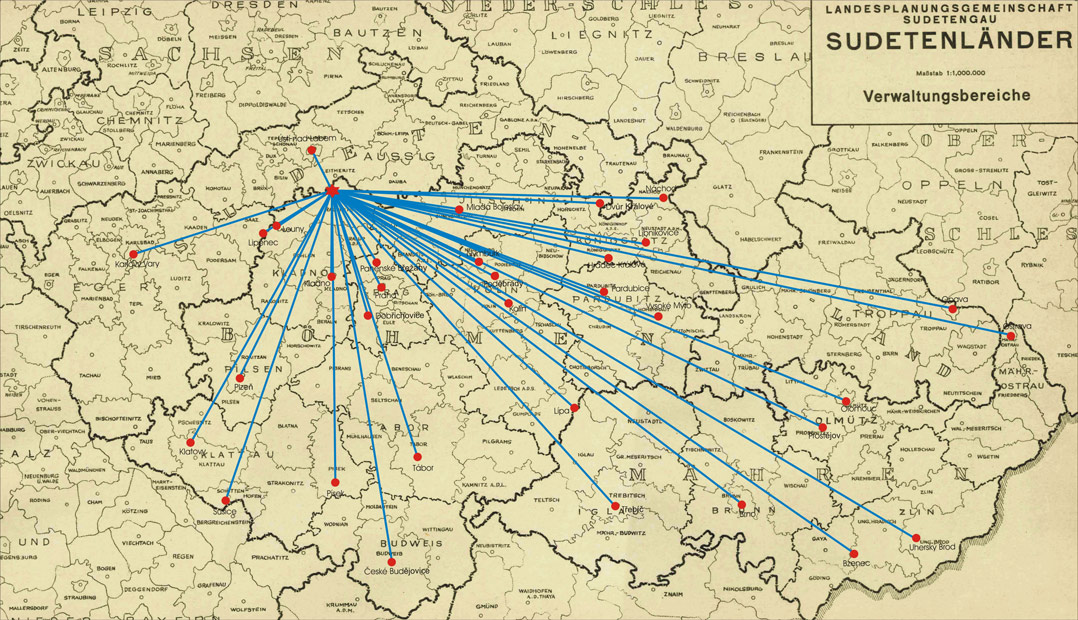 Fed by so many bleak tributaries, Terezín's misery became denser and denser, finally collapsing into a singularity of desolation. The inhabitants of the ghetto were crammed into attics and cellars, given next to no food, made to work 18 hours a day in freezing conditions, and beaten mercilessly. After only a few days, a majority of the population became severely diarrhetic. Next to no latrines or hygienic facilities were available in the ghetto, which soon became miry with waste and death.
During the first few days, death rates were low enough that bodies could still be buried, and funerals performed. However, as death rates climbed exponentially (literally), this quickly became impossible. The Nazis began work on a four-oven crematorium, which was completed in the fall of 1942. It ran continuously until the end of the war. Over 33,000 people died in the ghetto itself, and another 88,000 were sent to find certain death in liquidation camps to the east.

In this turbid course of events, a young girl of nascent artistic talent was separated from her father, who was placed in a different section of the ghetto. Through a fortuitous contact, she managed to smuggle a picture to him. She had drawn a snowman. On the back, she had written that she loved him. A few days later, the drawing was smuggled back to her. Her father had written that he loved her and that she ought not to draw snowmen. Instead, he had written: draw what you see. So, she drew one of the jagged, raw scenes so common in the ghetto and smuggled it to her father. It was returned to her blank, along the news that he had been put on a train car to Auschwitz a few days prior. His last words to her had been "draw what you see." So, she did. From then until the end of the war, she drew hundreds of bleak, realistic, and indelibly beautiful pictures of everyday life in the ghetto. Today, this body of work paints perhaps the most vibrant portrait of the Terezín ghetto we have:

While she drew away the years, a teacher on the other side of the ghetto led his gaunt students to a large, stately willow tree near the crematorium. He told them that after WWI, it had taken over five years for the members of his family to reunite with one another, scattered as they were by the war. He made his charges promise that when this had ended, they would return to the willow and find one another. Those who survived kept that promise, and today the scarred trunk of the Meeting Tree still stands in Terezín, just behind the crematorium, where it is visited by the descendants of those who reunited beneath its arched branches.

Terezín was liberated May 9, 1945, by the Soviet Army. Today, it is once again a small town of about 3,100 inhabitants.

Wednesday, February 3, 2010
Day Seventeen, in Which Wagner's Heart Breaks
"Hey, Honza."
"What?"
"Can you translate something into German for me?"
"What?"
"'You're breaking my heart, Max.' It's for a comic I'm drawing about Max Weber and Richard Wagner."
"What?"
"It's sort of a star-crossed lovers thing."
"What?"
Four minutes earlier:
I have come to believe that the clubs, pubs, and schlubs of Prague convene in a terribly muculent cellar nestled somewhere in the uncountable twists of the Prague underground in order to gather the most absurd collection of music possible and canonize it as The Prague Playlist. The List seems to largely be ruled by a tenuous coalition government between Lady Gaga, tearful raver-dropouts, and the song Infinity.
At this juncture, you should probably listen this song on YouTube or something.
It is more the less the aural fluid in which all other sonic experiences are suspended. However, I have this weird tic that comes from reading about two thousand pages more Weber than anyone should. I hear the song's ubiquitous lyric 'infinity' as 'modernity.' I don't know what's wrong with me either. This makes me picture Max Weber (stage name: Darth Weber) pursuing a career in the production of club music. This also makes me picture the illustrious German composer Richard Wagner being almost as bothered by this as he was by Jewish people. Also, I imagine Weber and Wagner palling around in Germany, not inviting Nietzsche to hang out with them at the opera and stuff. So, I sketched a little 3-panel bit before I got bored of the idea:

"What?"
"Can you translate something into German for me?"
"What?"
"'You're breaking my heart, Max.' It's for a comic I'm drawing about Max Weber and Richard Wagner."
"What?"
"It's sort of a star-crossed lovers thing."
"What?"
Four minutes earlier:
I have come to believe that the clubs, pubs, and schlubs of Prague convene in a terribly muculent cellar nestled somewhere in the uncountable twists of the Prague underground in order to gather the most absurd collection of music possible and canonize it as The Prague Playlist. The List seems to largely be ruled by a tenuous coalition government between Lady Gaga, tearful raver-dropouts, and the song Infinity.
At this juncture, you should probably listen this song on YouTube or something.
It is more the less the aural fluid in which all other sonic experiences are suspended. However, I have this weird tic that comes from reading about two thousand pages more Weber than anyone should. I hear the song's ubiquitous lyric 'infinity' as 'modernity.' I don't know what's wrong with me either. This makes me picture Max Weber (stage name: Darth Weber) pursuing a career in the production of club music. This also makes me picture the illustrious German composer Richard Wagner being almost as bothered by this as he was by Jewish people. Also, I imagine Weber and Wagner palling around in Germany, not inviting Nietzsche to hang out with them at the opera and stuff. So, I sketched a little 3-panel bit before I got bored of the idea:

Saturday, January 30, 2010
Day Thirteen, in Which the Narrator Travels to Kutná Hora
The skeletons left by communities propelled to great economic, architectural, and cultural heights by an unexpected boon before withering and dying when their lifeblood curdles are, for lack of a better word, awesome. Kutná Hora in central Bohemia is one such community. This is how one gets there from Prague:
View Larger Map
The discovery of silver around the turn of the first millennium was followed by centuries of mining in which Kutná Hora grew politically and economically. By the 14th century, half of the silver produced in all Europe came from Kutná Hora. It came to rival Prague as Bohemia's crown jewel, and a procession of Wenceslauses pirouetted across the city's burgeoning political stage.
However, a catastrophic flood and political unrest in the 16th century tarnished the city forever. Today, the town limps along largely on remnants of medieval glory. To wit:

Among these glories lurks reality:

But also more glory!

Kutná Hora also contains Sedlec Ossuary, one of the world's most terrifying ossuaries. As an ossuary is a reliquary for human bones, it does not come to this title lightly. This chandelier contains at least one of every bone in the human body:

The bones of between 40,000 and 70,000 persons cover the walls and ceilings of the ossuary.

The experience was deeply unnerving. This picture didn't come out how I intended, yet somehow captures the atmosphere better than any of the others I took:

View Larger Map
The discovery of silver around the turn of the first millennium was followed by centuries of mining in which Kutná Hora grew politically and economically. By the 14th century, half of the silver produced in all Europe came from Kutná Hora. It came to rival Prague as Bohemia's crown jewel, and a procession of Wenceslauses pirouetted across the city's burgeoning political stage.
However, a catastrophic flood and political unrest in the 16th century tarnished the city forever. Today, the town limps along largely on remnants of medieval glory. To wit:

Among these glories lurks reality:

But also more glory!

Kutná Hora also contains Sedlec Ossuary, one of the world's most terrifying ossuaries. As an ossuary is a reliquary for human bones, it does not come to this title lightly. This chandelier contains at least one of every bone in the human body:

The bones of between 40,000 and 70,000 persons cover the walls and ceilings of the ossuary.

The experience was deeply unnerving. This picture didn't come out how I intended, yet somehow captures the atmosphere better than any of the others I took:

Friday, January 29, 2010
Day Twelve, in Which Prague is Described Via Pluviā
About halfway up the Eastern European troposphere, a convective cell cycles merrily over Prague. Globules of water coalesce and become heavy enough to fall. Like cumuli Icari, they approach terminal velocity in the wintry air.
Spires come first, topped with icons baroque, medieval, renaissance, as though someone had torn out the pages of every architecture textbook in the world and stitched them into the sky with soot and snow. The spires are chased by steepled roofs obscured by slush waiting to be sluiced. A bit farther down and they’re no longer alone: a modern esoteria—knotted cables, television antennae, corrugated vents sighing industrial effluvia—gyres into they sky. Hamburger-shaped droplets (a raindrop at terminal velocity is not, in fact, teardrop-shaped, but more of a flattened, watery pâté) splatter on superannuated trelliswork and modernity’s refuse without discrimination. The lucky ones miss and find themselves flitting downward with buildings on either side. The backdrop rises, softly fluorescing a rainslick history: façades, art nouveau peccadilloes, ogives, columns, Soviet concrete. The last bit of precipitate lands and seeps into the miry slop by which the cobblestone is eclipsed.
King Wenceslas doesn’t blink as drops run down his soot-blackened face. If Wenceslas Square's post-Communist neon shroud doesn’t bother Bohemia’s patron saint, why should a little rain?
Spires come first, topped with icons baroque, medieval, renaissance, as though someone had torn out the pages of every architecture textbook in the world and stitched them into the sky with soot and snow. The spires are chased by steepled roofs obscured by slush waiting to be sluiced. A bit farther down and they’re no longer alone: a modern esoteria—knotted cables, television antennae, corrugated vents sighing industrial effluvia—gyres into they sky. Hamburger-shaped droplets (a raindrop at terminal velocity is not, in fact, teardrop-shaped, but more of a flattened, watery pâté) splatter on superannuated trelliswork and modernity’s refuse without discrimination. The lucky ones miss and find themselves flitting downward with buildings on either side. The backdrop rises, softly fluorescing a rainslick history: façades, art nouveau peccadilloes, ogives, columns, Soviet concrete. The last bit of precipitate lands and seeps into the miry slop by which the cobblestone is eclipsed.
King Wenceslas doesn’t blink as drops run down his soot-blackened face. If Wenceslas Square's post-Communist neon shroud doesn’t bother Bohemia’s patron saint, why should a little rain?
Sunday, January 24, 2010
Day Seven, in Which the Narrator Realizes There Are Some Things of Which He Will Never Tire
To wit: hearing the rules to King's Cup repeatedly explained in Czech; rereading Dancing Lessons for the Advanced in Age a million times; mléko; hearing Czech spoken with a thick Vietnamese accent; Czech English speakers who insist on using the present progressive tense for everything; Slovaks; rooming with a dude who reads Gogol and Chekhov in the original Russian; dancing for the sake of dancing; the exchange rate; Yevgeny Zamyatin; occasionally taking a night off; and the view from my room:

Things I may tire of but haven't yet: getting to the club at ten-thirty and leaving at four-thirty; T-Mobile CZ.
Things I've tired of already: the quantity of shattered glass on Czech dance floors. Unless one is wearing shoes with diamond-plated soles (Diddy?) the dully gleaming carpet of smashed glassware will lace the cracked rubber of your Cons with its tendrils, boring upward toward tender, tumescent feet. Glass-removal breaks every 90 minutes are indispensable. Oh, and British people. Quite sick of them.
Vocabulary: díky (thanks), ovlouvam se (sorry--a reflexive verb [!]), pivovar (brewery)

Things I may tire of but haven't yet: getting to the club at ten-thirty and leaving at four-thirty; T-Mobile CZ.
Things I've tired of already: the quantity of shattered glass on Czech dance floors. Unless one is wearing shoes with diamond-plated soles (Diddy?) the dully gleaming carpet of smashed glassware will lace the cracked rubber of your Cons with its tendrils, boring upward toward tender, tumescent feet. Glass-removal breaks every 90 minutes are indispensable. Oh, and British people. Quite sick of them.
Vocabulary: díky (thanks), ovlouvam se (sorry--a reflexive verb [!]), pivovar (brewery)
Thursday, January 21, 2010
Day Two (Evening) and Day Three, in Which the Candle is Burned at Every Conceivable End
My clothes have become a metaphor for my existence. Rumpled, prematurely careworn, covered with a slick patina of cigarette smoke, heavy beer, perspiration, Czech crowns, street slush and myriad other substances attendant to days and nights in Prague.
I haven't stopped moving since the moment I arrived four days ago except to briefly crash on my USSR bed (about two inches of padding) to chase few hours of elusive sleep. The experience thus far has been some combination of affecting, bewildering, challenging, and amazing. I'm searching for a word that refers to the process of internalizing a staggering amount of experiences and input all at once, constantly. There's probably a Czech word for it. The learning curve for this city and language is nearly vertical but I'm scaling it feverishly. Czech is inscrutable but fragments nevertheless stick on occasion. Especially when those fragments mean the difference between making it home and wandering in Vinohrady for three hours.
More later. Promise.
Vocabulary: děkuji (thank you), ze (from), do (to), prosím (please), pivo (beer)
I haven't stopped moving since the moment I arrived four days ago except to briefly crash on my USSR bed (about two inches of padding) to chase few hours of elusive sleep. The experience thus far has been some combination of affecting, bewildering, challenging, and amazing. I'm searching for a word that refers to the process of internalizing a staggering amount of experiences and input all at once, constantly. There's probably a Czech word for it. The learning curve for this city and language is nearly vertical but I'm scaling it feverishly. Czech is inscrutable but fragments nevertheless stick on occasion. Especially when those fragments mean the difference between making it home and wandering in Vinohrady for three hours.
More later. Promise.
Vocabulary: děkuji (thank you), ze (from), do (to), prosím (please), pivo (beer)
Wednesday, January 20, 2010
Day Two, in Which the Narrator Attempts to Pass for a Local
My sleep schedule having been obliterated long ago, I woke at about seven a.m. After eating breakfast, I decided to kill time with a predawn walk. One might think that wandering in a foreign city alone, in the dark, would meet study a abroad adviser's definition of "unsafe behavior."
One would be completely correct. In any event, I had a mission. The constant, instant labeling as an American by the locals (as deserved as it was) had motivated me. I wanted to successfully have an interaction with a Czech and have him or her come away with the impression that I was a local. As I speak no Czech, this was no mean feat. I would have to successfully make an initial impression that didn't disqualify me from being Czech, and then artfully maintain the deception through a series of well-timed grunts and noncommittal noises, all with the air of someone not merely confident in his environment, but utterly bored by it. I knew that my age and American shoes would work against me while my last name (clotted with Slavic consonants), closely-cropped hair, and ability to project cynicism as a facial expression would help me.
My target was the hapless cashier of the Tesco Express around the corner. I strode into his store from the predawn inclemency as though I had done it a thousand times before. As though I had any idea what a Tesco Express sells. I paused in front of a display of milk (mléko) and surveyed it disdainfully before, with blind decisiveness, selecting a bottle. I placed it on the counter and nodded to the clerk. There was a moment of tension in which I waited expectantly.
Success. He let loose a brief burst of incomprehensible Czech and rang up the milk. I watched the display for the amount of crowns and paid with a banknote, responding to a sustained enfilade of Czech with a grunt. It sailed through beautifully. I took my change, and brusquely marched out the door, relishing the simple Czech farewell that followed me into the darkness.
I drank my victory milk at a tram stop and watched kids across the street throw snowballs at one another in the rising light.
New Vocab: ahoj (hello), mléko (milk), pardon (excuse me)
One would be completely correct. In any event, I had a mission. The constant, instant labeling as an American by the locals (as deserved as it was) had motivated me. I wanted to successfully have an interaction with a Czech and have him or her come away with the impression that I was a local. As I speak no Czech, this was no mean feat. I would have to successfully make an initial impression that didn't disqualify me from being Czech, and then artfully maintain the deception through a series of well-timed grunts and noncommittal noises, all with the air of someone not merely confident in his environment, but utterly bored by it. I knew that my age and American shoes would work against me while my last name (clotted with Slavic consonants), closely-cropped hair, and ability to project cynicism as a facial expression would help me.
My target was the hapless cashier of the Tesco Express around the corner. I strode into his store from the predawn inclemency as though I had done it a thousand times before. As though I had any idea what a Tesco Express sells. I paused in front of a display of milk (mléko) and surveyed it disdainfully before, with blind decisiveness, selecting a bottle. I placed it on the counter and nodded to the clerk. There was a moment of tension in which I waited expectantly.
Success. He let loose a brief burst of incomprehensible Czech and rang up the milk. I watched the display for the amount of crowns and paid with a banknote, responding to a sustained enfilade of Czech with a grunt. It sailed through beautifully. I took my change, and brusquely marched out the door, relishing the simple Czech farewell that followed me into the darkness.
I drank my victory milk at a tram stop and watched kids across the street throw snowballs at one another in the rising light.
New Vocab: ahoj (hello), mléko (milk), pardon (excuse me)
Day One, in Which the Narrator Arrives
Writing about my experiences abroad is a constant struggle to avoid meandering, uninteresting ruminations about minutiae. The audience (let's assume there is one [humor me (please)]) doesn't care about the way Lufthansa's airplane's tray tables are latched or how toilets flush in Europe. (Do they?)
Having said that, experiences abroad are a collection of trivial, individually insignificant moments that coalesce into a transformative experience one can use to bore people at parties later on in life. Also, you can overpronounce foreign words.
I arrived via Frankfurt and, after a prolonged ballet involving luggage and orientation and introductions--the primary outcome of which is to make me forget the person's name less than a second after I hear it--there was time for a healthy meal at a Czech pub. Our choice of drink ran the gamut from "large beer" to "very large beer." Over a gently steaming plate of boiled potatoes and chicken fillet, I talked with a my new Czech friends about Hannah Arendt, stereotypes of Americans, residual resentment of communist ideology, American music from the 80s, and a few other things that got stuck somewhere in the barbed spines of the language barrier and bled to death between clusters of consonants and accent marks. Slowly.
Crashed early, drained by 20 hours of continuous travel.
New Vocab: Absolutely nothing. Tried to learn please and thank you, only succeeded in enunciating my own idiocy.
Having said that, experiences abroad are a collection of trivial, individually insignificant moments that coalesce into a transformative experience one can use to bore people at parties later on in life. Also, you can overpronounce foreign words.
I arrived via Frankfurt and, after a prolonged ballet involving luggage and orientation and introductions--the primary outcome of which is to make me forget the person's name less than a second after I hear it--there was time for a healthy meal at a Czech pub. Our choice of drink ran the gamut from "large beer" to "very large beer." Over a gently steaming plate of boiled potatoes and chicken fillet, I talked with a my new Czech friends about Hannah Arendt, stereotypes of Americans, residual resentment of communist ideology, American music from the 80s, and a few other things that got stuck somewhere in the barbed spines of the language barrier and bled to death between clusters of consonants and accent marks. Slowly.
Crashed early, drained by 20 hours of continuous travel.
New Vocab: Absolutely nothing. Tried to learn please and thank you, only succeeded in enunciating my own idiocy.
Subscribe to:
Posts (Atom)