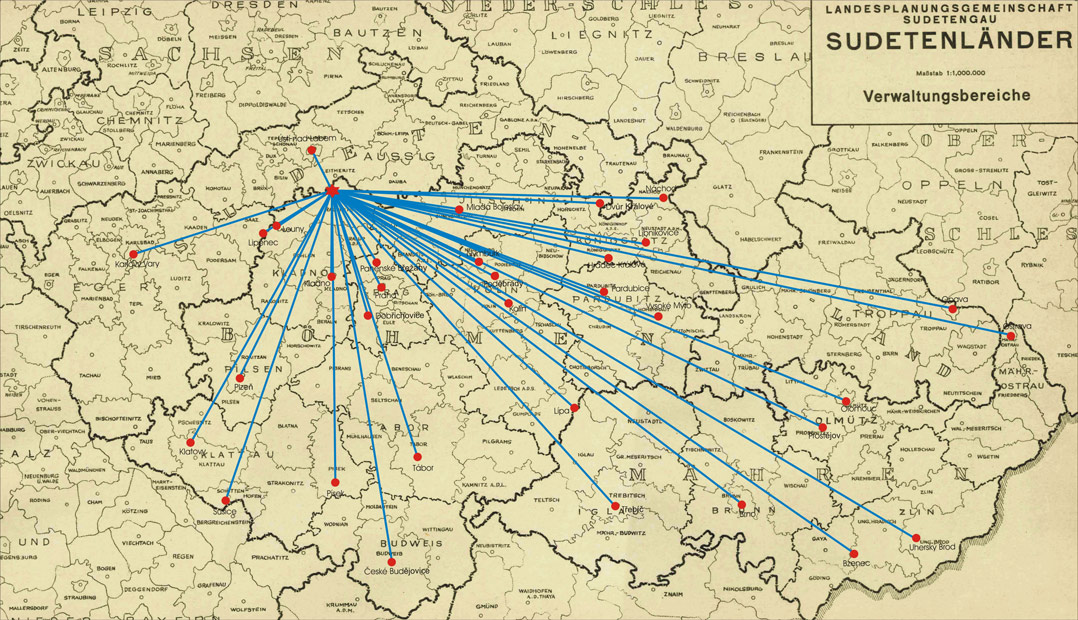
Earlier today, I found myself in the windswept northwest reaches of the Czech Republic, near the Czech-German border. I was visiting the town of Terezín and what is left of Lidice, which can no longer be called a town. Both are located in the Sudetenland, a patchwork of border regions that hem the edges of the Czech Republic. They are stitched together by the sinewy thread of a shared ethnic German population. In the lead-up to WWII, the Sudetenland was infamously ceded to Nazi Germany by
Neville Chamberlain & Co. in an effete attempt to forestall Hitler's towering barbarity. After the war, a majority of the ethnic Germans living there were
expelled by the Czechs as a reprisal for
the crimes of the Nazis. To this day, debate lingers among historian's swarthy minds as to whether or not this was an... overreaction. (Around a million Germans died as a result of post-WWII
reprisals across Europe.)
Lidice, once a thriving, provincial hamlet, no longer exists. This is where it used to be:
View Larger MapAfter two Czech paratroopers assassinated Reinhard Heydrich,
Reichsprotektor of Bohemia and Moravia, an apoplectic Hitler carried off several responses of increasing lunacy. Fairly far along this arc of madness lies the erasure of Lidice. On June 10, 1942, German soldiers entered the town and
shot, in groups of ten, every man over the age of 15. The women and children were shipped to concentration camps where nearly all of them died. Three Lidice families who happened to be out of town that day were tracked down and shot, and every structure in the town was blown out of the ground. Even the cemetery was dug up and bulldozed; the town in its entirety was physically eradicated. Today, a statue of the children of Lidice (nearly all of whom were gassed upon their arrival at
Chelmno extermination camp) looks over a field that contains nothing but snow and a few stone monuments.

After Lidice, I traveled further northwest, to Terezín. This is where Terezín is:
View Larger MapOriginally built in the 18th century as a military fortress by the Hapsburg Monarchy, Terezín was emptied of its original inhabitants in 1940 and converted into a Jewish ghetto. Its natural defenses were inverted for the purposes of keeping people in, and the town, formerly of 4,000 inhabitants, swelled with the weight of over 70,000. Terezín served as a major point of amalgamation for the Jewry of Eastern Europe. It was thousands' final checkpoint before Auschwitz. The consolidation, with Terezín as the locus:

Fed by so many bleak tributaries, Terezín's misery became denser and denser, finally collapsing into a singularity of desolation. The inhabitants of the ghetto were crammed into attics and cellars, given next to no food, made to work 18 hours a day in freezing conditions, and beaten mercilessly. After only a few days, a majority of the population became severely diarrhetic. Next to no latrines or hygienic facilities were available in the ghetto, which soon became miry with waste and death.

During the first few days, death rates were low enough that bodies could still be buried, and funerals performed. However, as death rates climbed exponentially (literally), this quickly became impossible. The Nazis began work on a four-oven crematorium, which was completed in the fall of 1942. It ran continuously until the end of the war. Over 33,000 people died in the ghetto itself, and another 88,000 were sent to find certain death in liquidation camps to the east.

In this turbid course of events, a young girl of nascent artistic talent was separated from her father, who was placed in a different section of the ghetto. Through a fortuitous contact, she managed to smuggle a picture to him. She had drawn a snowman. On the back, she had written that she loved him. A few days later, the drawing was smuggled back to her. Her father had written that he loved her and that she ought not to draw snowmen. Instead, he had written:
draw what you see. So, she drew one of the jagged, raw scenes so common in the ghetto and smuggled it to her father. It was returned to her blank, along the news that he had been put on a train car to Auschwitz a few days prior. His last words to her had been "draw what you see." So, she did. From then until the end of the war, she drew hundreds of bleak, realistic, and indelibly beautiful pictures of everyday life in the ghetto. Today, this body of work paints perhaps the most vibrant portrait of the Terezín ghetto we have:

While she drew away the years, a teacher on the other side of the ghetto led his gaunt students to a large, stately willow tree near the crematorium. He told them that after WWI, it had taken over five years for the members of his family to reunite with one another, scattered as they were by the war. He made his charges promise that when
this had ended, they would return to the willow and find one another. Those who survived kept that promise, and today the scarred trunk of the Meeting Tree still stands in Terezín, just behind the crematorium, where it is visited by the descendants of those who reunited beneath its arched branches.

Terezín was liberated May 9, 1945, by the Soviet Army. Today, it is once again a small town of about 3,100 inhabitants.