Showing posts with label photos. Show all posts

Sunday, June 20, 2010

Day One Hundred Fifty-four, in Which the Narrator Travels the Balkans

I had always thought "the rain fell in sheets" was poetic license. That was before Croatia. Three days later, my notebook has for us this smeary testament:

Zagreb, Croatia -- under the meager rainshadow of the train platform. across the tracks some sort of monstrous communist-era building has mounted on it two floodlights that spray parallel arcs of twinkling white-lit raindrops [indecipherable] riding the wind in surges. lightning made purple by some atmospheric confluence veins the sky. the platform shelter is riddled with network of cracks and gaps through which rainwater mists or drips or pours, depending on the character of the rent. the wind is blowing [indecipherable]


I remember the lightning, the way it made the sky purple in lines and flashes. The drainage system was a wreck.


A day earlier, I was enjoying the sun in Ljubljana, Slovenia. I still have some family there, but I wasn't nearly organized enough to look them up (should have). I had arrived the day before on a night train from Vienna (small, convoluted, bloated from an addiction to tourism). It was raining and dark, so I slept on the platform with a homeless guy. I woke up at seven. It was bright and clear. I explored. My hostel was excellent--a former prison-turned artists' atelier/creative space/gallery-turned hostel. It's called Hostel Celica. Look it up if you're ever in Ljubljana.

Slovenia was interesting in no small measure because of the undeniable echoes of its desire to Westernize.


Every country of the former Soviet Bloc has this, to an extent--a compulsion to present itself as as capital-W Western as possible. (Each country has its own goofy, selfconscious catchphrases you'll inevitably hear if you spend enough time talking to locals. Czech Republic: "Prague is West of Vienna" Slovenia: "We're not Slavic, we're 'Venetic'" Bosnia: "We hosted the Olympics once" &c.) It was interesting. A short example: I exited the train station and saw a modest plaster-and-brick house just outside the station. On the side, in neat grey letters, someone had painted in English: COMPUTER COMPANY. A decal of a computer adorned the window, as if to further demonstrate the point. There was a homework-on-the-fridge quality to it.


A further point of endearment: my surname being recognized and treated with an easy familiarity, the way "Johnson" or "Moore" would be in the US. It's a weird sort of privilege/convenience, something difficult to describe, and probably inexplicable--to some degree--to someone grew up with a name store clerks could always spell without help.


My final stop was Bosnia. When I bought a one-way ticket to Sarajevo, the Croatian ticket taker raised her eyebrows and repeated my destination sotto voce. Yes, I said.

The train was nearly empty. Cigarette ash was smeared on nearly every surface of my compartment. I fell asleep quickly. Shortly after three a.m., a uniformed man entered my compartment. He was a short, fat man in an ill-fitting uniform with Cyrillic lettering. I gave him my passport. He asked where I was from in the US. When I said Alaska, his face lit up. He pushed a hand into his chest (as though pledging to some unseen entity) and told me visiting it was his dream. He said it not like it was tangible dream, but more in the manner I would describe wishing to visit the moon: something tremendous not only for its own sake, but also for the elegant impossibility of its realization. I told him it was beautiful there and he repeated it as though fingering a rosary: "Yes, it is beautiful there. It is beautiful there. It is beautiful." He corrected himself after a few repetitions: "She is beautiful."

The city itself was bullet-riddled and fascinating. The skyline is stippled with minarets. Graveyards dot the hillsides. Most of the death dates fall in the mid-90s.


I went to the old Olympic stadium and visited the museum. I was the third visitor in the month of June.

There's an identifiable manner in which a person who has experienced war in his or her native country carries this experience. I talked to some Bosnian students at one point. They were about my age which means they were, what, eight or so when the war ended? At one point, a girl named Manuela mentioned laughingly that we'd all be dead in 2013 anyway. Thinking she was referencing the Mayan calendar, I asked if she meant 2012. No, she said, there's going to be war as Europe has never known in 2013. Someone asked her what she meant. She shrugged and said she'd heard it from a man on television. He said the living would envy the dead, she said.

Most people I've encountered who lend credence to apocalyptic theory do it with a sort of earnest acceptance of or even enthusiasm for its fantastic quality, the unreal nature of things like "the end of time" and death and destruction on a massive scale. Manuela regarded this future war in an entirely different way. She talked about it like the weather. She could have been talking about whether traffic would be bad next Monday.

I realized, sitting there, that certain things were real for her that would never be real for me.

Thursday, April 22, 2010

Day Ninety-five, in Which Prague has Sprung

Sometime in January, was it? I posted this picture of the view from my window:


The same view has since appreciated such that it demands our appreciation:


Moc hezký
.

Saturday, April 3, 2010

Day Seventy-six, in Which Kraków Abides

This past weekend, I embarked on a journey both dense and expansive enough that it would be a criminal omission to not render it here. It could be passably described as 44 interlocking hours of ecstasies and miseries.

Thursday, 8 a.m. -- Wake blearily. Attend Czech.

Thursday, noon -- Better-than-expected lunch of tuna salad and milk. Study theories of totalitarianism.

Thursday, 5 p.m. -- The battle of the totalitarianism midterm is joined. Rivulets of ink spilled instead of blood.

Thursday, shortly before midnight -- Across Prague. Board a bus bound for Kraków.

Friday, 12 to 6 a.m. -- Bus ride:


View Larger Map

Friday, 8 a.m. -- Auschwitz, camp I. Imbued with a dense sort of terror. Buttoned-up horror.


Friday, 10 a.m. -- Auschwitz-Birkenau, camp II. A sprawling, fathomless abomination.


Friday, 2 p.m. -- A tour of Kraków's undersized but teeming city center. Saw Oskar Schindler's factory. Took forgettable pictures.


Friday, 8 p.m. -- Dinner and nightlife commence. 170,000 of Kraków's 750,000 inhabitants are students. Revelry here glistens with a youthful sheen and is well above average for Eastern Europe. The language, when spoken, is similar to Czech. Though far from intelligible, it occasionally lent itself to comprehension.


Saturday, early morning -- My 44-hour day ends as it began: blearily.

Sorry this is a touch terse, but I'm moderately compressed by time (orlackthereof).

I am also without the descriptive power to do Auschwitz justice, or even cast the faintest shadow of a meaningful description here.

Sunday, February 28, 2010

Day Forty-one, in Which the Háje Paneláky Are Visited

About sixty years ago, the Czechoslovak government's urban planners came together in what I imagine to be a cacophonous goulash of adderall and ideology and produced the sort of idea that normally comes from, well, communist urban planners. This idea was to make as many citizens as humanly possible live in as few structures as possible. For, you know, solidarity. This led to the panelák, a dense, concrete monolith teeming with inhabitants crammed between its paper-thin walls. Built in monotonous clusters, the resultant panelák communities often saw tens of thousands of people living on one block. One of the most notorious panelák communities is Háje, an insular grouping of paneláky clinging to the gaunt outskirts of Prague. It lies at the very end of Prague's longest metro line, which is where I, unassumingly dressed, disembarked earlier today.

For your spatial frame of reference:

View Larger Map

Ascending from the metro, I found myself in a courtyard bound by a thousand balconies. Paneláky rose on all sides. Defeated-looking grass clung to life among patches of brown snow and black dirt. Cigarette butts populated the ground at a rate of thirty per square meter--assuming a courtyard of 40x55m and accurate observation on my part, 66,000 in this courtyard alone.

At first, I was a shade underwhelmed. However, as each monstrous panelák I passed dutifully revealed another concrete expanse behind it, I began to feel the true enormity of this place. I wandered aimlessly through a world punctuated at every instance by concreted towers ripe with humanity: catenary clotheslines sagging with tablecloths, paisley skirts, and children's stained denim; cockeyed satellite dishes supported by erector-set construction; lawn chars perched on cinder blocks and mattresses; chainsmokers nestled in 14th-story roosts; soccer balls, shriveled and cracked. These human obelisks extended in every direction, a raw sprawl.

As I ambled through this endlessly drab but indisputably alive world, a rising sense of unreality took me. I began to internalize the unbending repetition, mechanically taking photographs and jotting notes. I don't know how long I meandered; time became gossamer and slick, slipped its clothespins.

Though I had arrived in mid-afternoon, I found the sun just moments from setting. Quoting from my notes at the time:

walking the grubby streets, light reflected from the windows is unexpectedly sandia [watermelon-colored]. when did the sun start setting? I'm seized by the irrational presentiment that when darkness falls here, the exits close and this bubble becomes isolated not only geographically, but breaks loose temporally. the inexplicable sensation of being trapped here when night falls, stuck in an anachronistic communist dream forever.


As I wound an uncertain way back through dusky streets, my feeling of unreality began to distill into something new. At first, I couldn't qualify the resultant feeling. Eventually, however, I was able to put it on paper:

here is the place in which the 20th-cent. fascination with modernity has been refined and brought to bear, poured into this place like a leaden glaze. everything drips with it, slick and sodden.
I have never felt more anonymous.

Sunday, February 21, 2010

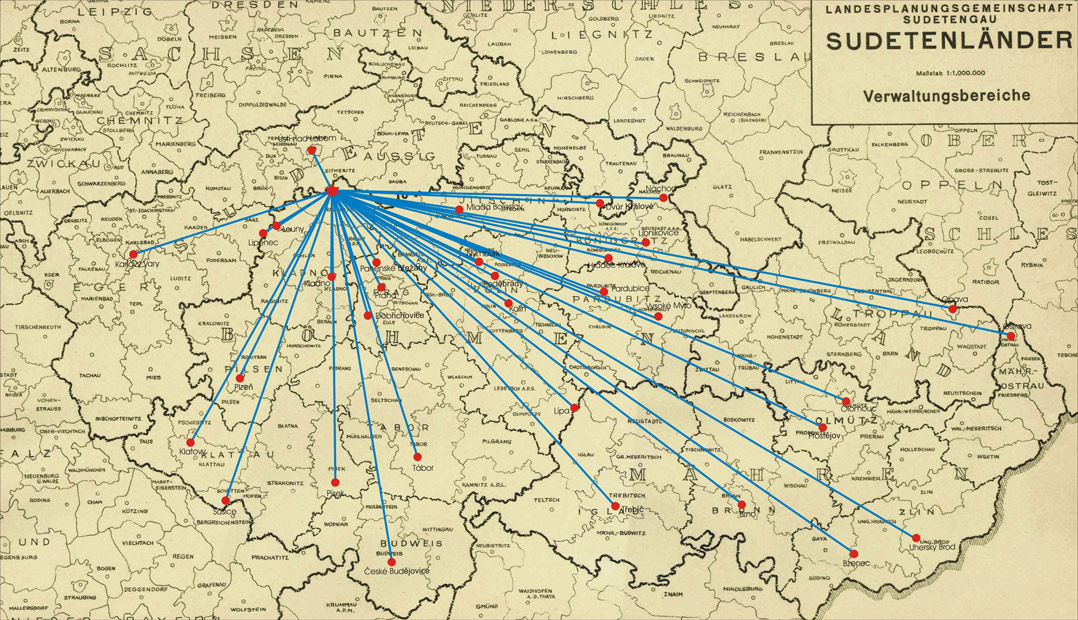
Day Thirty-four, in Which the Narrator Travels to the Sudetenland

Earlier today, I found myself in the windswept northwest reaches of the Czech Republic, near the Czech-German border. I was visiting the town of Terezín and what is left of Lidice, which can no longer be called a town. Both are located in the Sudetenland, a patchwork of border regions that hem the edges of the Czech Republic. They are stitched together by the sinewy thread of a shared ethnic German population. In the lead-up to WWII, the Sudetenland was infamously ceded to Nazi Germany by Neville Chamberlain & Co. in an effete attempt to forestall Hitler's towering barbarity. After the war, a majority of the ethnic Germans living there were expelled by the Czechs as a reprisal for the crimes of the Nazis. To this day, debate lingers among historian's swarthy minds as to whether or not this was an... overreaction. (Around a million Germans died as a result of post-WWII reprisals across Europe.)

Lidice, once a thriving, provincial hamlet, no longer exists. This is where it used to be:

View Larger Map

After two Czech paratroopers assassinated Reinhard Heydrich, Reichsprotektor of Bohemia and Moravia, an apoplectic Hitler carried off several responses of increasing lunacy. Fairly far along this arc of madness lies the erasure of Lidice. On June 10, 1942, German soldiers entered the town and shot, in groups of ten, every man over the age of 15. The women and children were shipped to concentration camps where nearly all of them died. Three Lidice families who happened to be out of town that day were tracked down and shot, and every structure in the town was blown out of the ground. Even the cemetery was dug up and bulldozed; the town in its entirety was physically eradicated. Today, a statue of the children of Lidice (nearly all of whom were gassed upon their arrival at Chelmno extermination camp) looks over a field that contains nothing but snow and a few stone monuments.


After Lidice, I traveled further northwest, to Terezín. This is where Terezín is:

View Larger Map

Originally built in the 18th century as a military fortress by the Hapsburg Monarchy, Terezín was emptied of its original inhabitants in 1940 and converted into a Jewish ghetto. Its natural defenses were inverted for the purposes of keeping people in, and the town, formerly of 4,000 inhabitants, swelled with the weight of over 70,000. Terezín served as a major point of amalgamation for the Jewry of Eastern Europe. It was thousands' final checkpoint before Auschwitz. The consolidation, with Terezín as the locus:
Fed by so many bleak tributaries, Terezín's misery became denser and denser, finally collapsing into a singularity of desolation. The inhabitants of the ghetto were crammed into attics and cellars, given next to no food, made to work 18 hours a day in freezing conditions, and beaten mercilessly. After only a few days, a majority of the population became severely diarrhetic. Next to no latrines or hygienic facilities were available in the ghetto, which soon became miry with waste and death.

During the first few days, death rates were low enough that bodies could still be buried, and funerals performed. However, as death rates climbed exponentially (literally), this quickly became impossible. The Nazis began work on a four-oven crematorium, which was completed in the fall of 1942. It ran continuously until the end of the war. Over 33,000 people died in the ghetto itself, and another 88,000 were sent to find certain death in liquidation camps to the east.

In this turbid course of events, a young girl of nascent artistic talent was separated from her father, who was placed in a different section of the ghetto. Through a fortuitous contact, she managed to smuggle a picture to him. She had drawn a snowman. On the back, she had written that she loved him. A few days later, the drawing was smuggled back to her. Her father had written that he loved her and that she ought not to draw snowmen. Instead, he had written: draw what you see. So, she drew one of the jagged, raw scenes so common in the ghetto and smuggled it to her father. It was returned to her blank, along the news that he had been put on a train car to Auschwitz a few days prior. His last words to her had been "draw what you see." So, she did. From then until the end of the war, she drew hundreds of bleak, realistic, and indelibly beautiful pictures of everyday life in the ghetto. Today, this body of work paints perhaps the most vibrant portrait of the Terezín ghetto we have:

While she drew away the years, a teacher on the other side of the ghetto led his gaunt students to a large, stately willow tree near the crematorium. He told them that after WWI, it had taken over five years for the members of his family to reunite with one another, scattered as they were by the war. He made his charges promise that when this had ended, they would return to the willow and find one another. Those who survived kept that promise, and today the scarred trunk of the Meeting Tree still stands in Terezín, just behind the crematorium, where it is visited by the descendants of those who reunited beneath its arched branches.

Terezín was liberated May 9, 1945, by the Soviet Army. Today, it is once again a small town of about 3,100 inhabitants.

Wednesday, February 3, 2010

Day Seventeen, in Which Wagner's Heart Breaks

"Hey, Honza."
"What?"
"Can you translate something into German for me?"
"What?"
"'You're breaking my heart, Max.' It's for a comic I'm drawing about Max Weber and Richard Wagner."
"What?"
"It's sort of a star-crossed lovers thing."
"What?"

Four minutes earlier:

I have come to believe that the clubs, pubs, and schlubs of Prague convene in a terribly muculent cellar nestled somewhere in the uncountable twists of the Prague underground in order to gather the most absurd collection of music possible and canonize it as The Prague Playlist. The List seems to largely be ruled by a tenuous coalition government between Lady Gaga, tearful raver-dropouts, and the song Infinity.

At this juncture, you should probably listen this song on YouTube or something.

It is more the less the aural fluid in which all other sonic experiences are suspended. However, I have this weird tic that comes from reading about two thousand pages more Weber than anyone should. I hear the song's ubiquitous lyric 'infinity' as 'modernity.' I don't know what's wrong with me either. This makes me picture Max Weber (stage name: Darth Weber) pursuing a career in the production of club music. This also makes me picture the illustrious German composer Richard Wagner being almost as bothered by this as he was by Jewish people. Also, I imagine Weber and Wagner palling around in Germany, not inviting Nietzsche to hang out with them at the opera and stuff. So, I sketched a little 3-panel bit before I got bored of the idea:

Saturday, January 30, 2010

Day Thirteen, in Which the Narrator Travels to Kutná Hora

The skeletons left by communities propelled to great economic, architectural, and cultural heights by an unexpected boon before withering and dying when their lifeblood curdles are, for lack of a better word, awesome. Kutná Hora in central Bohemia is one such community. This is how one gets there from Prague:


View Larger Map

The discovery of silver around the turn of the first millennium was followed by centuries of mining in which Kutná Hora grew politically and economically. By the 14th century, half of the silver produced in all Europe came from Kutná Hora. It came to rival Prague as Bohemia's crown jewel, and a procession of Wenceslauses pirouetted across the city's burgeoning political stage.

However, a catastrophic flood and political unrest in the 16th century tarnished the city forever. Today, the town limps along largely on remnants of medieval glory. To wit:


Among these glories lurks reality:


But also more glory!


Kutná Hora also contains Sedlec Ossuary, one of the world's most terrifying ossuaries. As an ossuary is a reliquary for human bones, it does not come to this title lightly. This chandelier contains at least one of every bone in the human body:


The bones of between 40,000 and 70,000 persons cover the walls and ceilings of the ossuary.


The experience was deeply unnerving. This picture didn't come out how I intended, yet somehow captures the atmosphere better than any of the others I took:

Sunday, January 24, 2010

Day Seven, in Which the Narrator Realizes There Are Some Things of Which He Will Never Tire

To wit: hearing the rules to King's Cup repeatedly explained in Czech; rereading Dancing Lessons for the Advanced in Age a million times; mléko; hearing Czech spoken with a thick Vietnamese accent; Czech English speakers who insist on using the present progressive tense for everything; Slovaks; rooming with a dude who reads Gogol and Chekhov in the original Russian; dancing for the sake of dancing; the exchange rate; Yevgeny Zamyatin; occasionally taking a night off; and the view from my room:


Things I may tire of but haven't yet: getting to the club at ten-thirty and leaving at four-thirty; T-Mobile CZ.

Things I've tired of already: the quantity of shattered glass on Czech dance floors. Unless one is wearing shoes with diamond-plated soles (Diddy?) the dully gleaming carpet of smashed glassware will lace the cracked rubber of your Cons with its tendrils, boring upward toward tender, tumescent feet. Glass-removal breaks every 90 minutes are indispensable. Oh, and British people. Quite sick of them.

Vocabulary: díky (thanks), ovlouvam se (sorry--a reflexive verb [!]), pivovar (brewery)
 
 
Copyright © Prague Grog Fog Blog
Blogger Theme by BloggerThemes Design by Diovo.com