I've been part of social groups a hair away from dissolution before: the end of elementary school; the end of summer camp; the end of high school; a friend group (or five) held together by a set of relationships become newly tenuous.
But: I've never been in social group so aware of its own impending disintegration. We're no longer sufficiently callow, maybe. So, this, this: this fairly homogeneous group of 94 (give, take) students from 30 or so different colleges. Our social graph has a strange destiny: mesa. A sharp uptick four months ago, a plateau in which the only undulations are slight, those of formulaic social recalibration, and then a searing plunge, hardly tempered by faint promises of reconciliation and quixotic Facebooking. The precipice doesn't come until next week, but there's a palpable sensation of cessation, punctuated like the tick, tick, tick of an ascending roller-coaster. It slips beneath the pregamed dancing and smeary conversation the way dark matter pirouettes behind regular matter, changing the way galaxies rotate and bending light from distant stars. Or, to shift cosmological metaphors, background radiation: It's not something anyone thinks or talks about on the daily, but turn your rabbit ears between the channels and try to tell me there's no static. I imagine it sort of like a group of houseguests who can see that, yeah, the house is on fire, sure, but the drapes haven't even caught yet so here's another Gaga track. That's not to suggest we should all run out of the house, sooty and hysterical, and stand on the lawn and watch it burn and go home and listen to The Shins: I'm not Paul Revere, here. To go out in my tricorne and cry "THE END IS COMING" is about as prophetic as shouting "THIS IS THE OLDEST WE'VE EVER BEEN" or "IN FOUR YEARS, A MAJORITY OF US WILL BE MARRIED."
We know. Don't remind us. The carpet's barely smoldering, anyway.
Monday, May 10, 2010

Thursday, April 22, 2010
Day Ninety-five, in Which Prague has Sprung
Sometime in January, was it? I posted this picture of the view from my window:

The same view has since appreciated such that it demands our appreciation:

Moc hezký.

The same view has since appreciated such that it demands our appreciation:

Moc hezký.
Sunday, April 11, 2010
Day Eighty-four, in Which the Narrator is Irradiated
"This is a unique experience; I don't think they usually let people into uranium mines."
"For a pretty good reason, right?"
"Well, they aired it out yesterday."
"Aired it out? Can you do that with radiation? Just air it out?"
"I'm not sure."
"I really don't think you can."
And so we descended into the invisibly pulsing mines of Jáchymov. Map:

The world has Jáchymov to 'thank' for about five things:
So: sort of a mixed bag. That's a metaphor I try to stay away from, because it's tired and pallid, but I also try to stay away from uranium, so. Also, I think if we take the metaphorical vehicle as a burlap sack stuffed with uranium ore, fine silverware, and an ICBM, it can't help but illuminate the point.
Before we were standing in the wet, narrow shaft listening to the (divinely affecting and directly told--imagine Vonnegut's sensibility for sincerity in the face of apocalyptic horror) stories of a former political prisoner made to work in the mines, we visited the camp at which the ore was processed. It was also staffed (word choice) by political prisoners. The thematic and visual center of the camp was Věž smrti--the tower of death. In it, prisoners were tasked with grinding down high-quality uranium for shipment to the USSR. The air was continually saturated with impossibly poisonous uranium dust. A short time in the tower was more than enough to forever conclude one's prospects for leading a healthy life; scoliosis and cancer filtered out of the tower in neverending waves, borne by the workers' frail bodies.
Afterward, we went and saw a castle on a cliff.
"For a pretty good reason, right?"
"Well, they aired it out yesterday."
"Aired it out? Can you do that with radiation? Just air it out?"
"I'm not sure."
"I really don't think you can."
And so we descended into the invisibly pulsing mines of Jáchymov. Map:

The world has Jáchymov to 'thank' for about five things:
- The word dollar, which came from thaler, which came from a hip twist on Jáchymov;
- eleven tons of silver, give or take a few million dollars' worth;
- the element radium, which Marie Curie discovered here before it killed her and claimed its rightful place as the most ungrateful of the alkaline earth metals;
- a couple hundred Soviet nuclear weapons; and
- this blog post.
So: sort of a mixed bag. That's a metaphor I try to stay away from, because it's tired and pallid, but I also try to stay away from uranium, so. Also, I think if we take the metaphorical vehicle as a burlap sack stuffed with uranium ore, fine silverware, and an ICBM, it can't help but illuminate the point.
Before we were standing in the wet, narrow shaft listening to the (divinely affecting and directly told--imagine Vonnegut's sensibility for sincerity in the face of apocalyptic horror) stories of a former political prisoner made to work in the mines, we visited the camp at which the ore was processed. It was also staffed (word choice) by political prisoners. The thematic and visual center of the camp was Věž smrti--the tower of death. In it, prisoners were tasked with grinding down high-quality uranium for shipment to the USSR. The air was continually saturated with impossibly poisonous uranium dust. A short time in the tower was more than enough to forever conclude one's prospects for leading a healthy life; scoliosis and cancer filtered out of the tower in neverending waves, borne by the workers' frail bodies.
Afterward, we went and saw a castle on a cliff.
Saturday, April 3, 2010
Day Seventy-six, in Which Kraków Abides
This past weekend, I embarked on a journey both dense and expansive enough that it would be a criminal omission to not render it here. It could be passably described as 44 interlocking hours of ecstasies and miseries.
Thursday, 8 a.m. -- Wake blearily. Attend Czech.
Thursday, noon -- Better-than-expected lunch of tuna salad and milk. Study theories of totalitarianism.
Thursday, 5 p.m. -- The battle of the totalitarianism midterm is joined. Rivulets of ink spilled instead of blood.
Thursday, shortly before midnight -- Across Prague. Board a bus bound for Kraków.
Friday, 12 to 6 a.m. -- Bus ride:
View Larger Map
Friday, 8 a.m. -- Auschwitz, camp I. Imbued with a dense sort of terror. Buttoned-up horror.


Friday, 10 a.m. -- Auschwitz-Birkenau, camp II. A sprawling, fathomless abomination.


Friday, 2 p.m. -- A tour of Kraków's undersized but teeming city center. Saw Oskar Schindler's factory. Took forgettable pictures.

Friday, 8 p.m. -- Dinner and nightlife commence. 170,000 of Kraków's 750,000 inhabitants are students. Revelry here glistens with a youthful sheen and is well above average for Eastern Europe. The language, when spoken, is similar to Czech. Though far from intelligible, it occasionally lent itself to comprehension.

Saturday, early morning -- My 44-hour day ends as it began: blearily.
Sorry this is a touch terse, but I'm moderately compressed by time (orlackthereof).
I am also without the descriptive power to do Auschwitz justice, or even cast the faintest shadow of a meaningful description here.
Sunday, February 28, 2010
Day Forty-one, in Which the Háje Paneláky Are Visited
About sixty years ago, the Czechoslovak government's urban planners came together in what I imagine to be a cacophonous goulash of adderall and ideology and produced the sort of idea that normally comes from, well, communist urban planners. This idea was to make as many citizens as humanly possible live in as few structures as possible. For, you know, solidarity. This led to the panelák, a dense, concrete monolith teeming with inhabitants crammed between its paper-thin walls. Built in monotonous clusters, the resultant panelák communities often saw tens of thousands of people living on one block. One of the most notorious panelák communities is Háje, an insular grouping of paneláky clinging to the gaunt outskirts of Prague. It lies at the very end of Prague's longest metro line, which is where I, unassumingly dressed, disembarked earlier today.
For your spatial frame of reference:
View Larger Map
Ascending from the metro, I found myself in a courtyard bound by a thousand balconies. Paneláky rose on all sides. Defeated-looking grass clung to life among patches of brown snow and black dirt. Cigarette butts populated the ground at a rate of thirty per square meter--assuming a courtyard of 40x55m and accurate observation on my part, 66,000 in this courtyard alone.

At first, I was a shade underwhelmed. However, as each monstrous panelák I passed dutifully revealed another concrete expanse behind it, I began to feel the true enormity of this place. I wandered aimlessly through a world punctuated at every instance by concreted towers ripe with humanity: catenary clotheslines sagging with tablecloths, paisley skirts, and children's stained denim; cockeyed satellite dishes supported by erector-set construction; lawn chars perched on cinder blocks and mattresses; chainsmokers nestled in 14th-story roosts; soccer balls, shriveled and cracked. These human obelisks extended in every direction, a raw sprawl.

As I ambled through this endlessly drab but indisputably alive world, a rising sense of unreality took me. I began to internalize the unbending repetition, mechanically taking photographs and jotting notes. I don't know how long I meandered; time became gossamer and slick, slipped its clothespins.

Though I had arrived in mid-afternoon, I found the sun just moments from setting. Quoting from my notes at the time:

As I wound an uncertain way back through dusky streets, my feeling of unreality began to distill into something new. At first, I couldn't qualify the resultant feeling. Eventually, however, I was able to put it on paper:
For your spatial frame of reference:
View Larger Map
Ascending from the metro, I found myself in a courtyard bound by a thousand balconies. Paneláky rose on all sides. Defeated-looking grass clung to life among patches of brown snow and black dirt. Cigarette butts populated the ground at a rate of thirty per square meter--assuming a courtyard of 40x55m and accurate observation on my part, 66,000 in this courtyard alone.

At first, I was a shade underwhelmed. However, as each monstrous panelák I passed dutifully revealed another concrete expanse behind it, I began to feel the true enormity of this place. I wandered aimlessly through a world punctuated at every instance by concreted towers ripe with humanity: catenary clotheslines sagging with tablecloths, paisley skirts, and children's stained denim; cockeyed satellite dishes supported by erector-set construction; lawn chars perched on cinder blocks and mattresses; chainsmokers nestled in 14th-story roosts; soccer balls, shriveled and cracked. These human obelisks extended in every direction, a raw sprawl.

As I ambled through this endlessly drab but indisputably alive world, a rising sense of unreality took me. I began to internalize the unbending repetition, mechanically taking photographs and jotting notes. I don't know how long I meandered; time became gossamer and slick, slipped its clothespins.

Though I had arrived in mid-afternoon, I found the sun just moments from setting. Quoting from my notes at the time:
walking the grubby streets, light reflected from the windows is unexpectedly sandia [watermelon-colored]. when did the sun start setting? I'm seized by the irrational presentiment that when darkness falls here, the exits close and this bubble becomes isolated not only geographically, but breaks loose temporally. the inexplicable sensation of being trapped here when night falls, stuck in an anachronistic communist dream forever.

As I wound an uncertain way back through dusky streets, my feeling of unreality began to distill into something new. At first, I couldn't qualify the resultant feeling. Eventually, however, I was able to put it on paper:
here is the place in which the 20th-cent. fascination with modernity has been refined and brought to bear, poured into this place like a leaden glaze. everything drips with it, slick and sodden.
I have never felt more anonymous.
Sunday, February 21, 2010
Day Thirty-four, in Which the Narrator Travels to the Sudetenland
Earlier today, I found myself in the windswept northwest reaches of the Czech Republic, near the Czech-German border. I was visiting the town of Terezín and what is left of Lidice, which can no longer be called a town. Both are located in the Sudetenland, a patchwork of border regions that hem the edges of the Czech Republic. They are stitched together by the sinewy thread of a shared ethnic German population. In the lead-up to WWII, the Sudetenland was infamously ceded to Nazi Germany by Neville Chamberlain & Co. in an effete attempt to forestall Hitler's towering barbarity. After the war, a majority of the ethnic Germans living there were expelled by the Czechs as a reprisal for the crimes of the Nazis. To this day, debate lingers among historian's swarthy minds as to whether or not this was an... overreaction. (Around a million Germans died as a result of post-WWII reprisals across Europe.)
Lidice, once a thriving, provincial hamlet, no longer exists. This is where it used to be:
View Larger Map
After two Czech paratroopers assassinated Reinhard Heydrich, Reichsprotektor of Bohemia and Moravia, an apoplectic Hitler carried off several responses of increasing lunacy. Fairly far along this arc of madness lies the erasure of Lidice. On June 10, 1942, German soldiers entered the town and shot, in groups of ten, every man over the age of 15. The women and children were shipped to concentration camps where nearly all of them died. Three Lidice families who happened to be out of town that day were tracked down and shot, and every structure in the town was blown out of the ground. Even the cemetery was dug up and bulldozed; the town in its entirety was physically eradicated. Today, a statue of the children of Lidice (nearly all of whom were gassed upon their arrival at Chelmno extermination camp) looks over a field that contains nothing but snow and a few stone monuments.

After Lidice, I traveled further northwest, to Terezín. This is where Terezín is:
View Larger Map
Originally built in the 18th century as a military fortress by the Hapsburg Monarchy, Terezín was emptied of its original inhabitants in 1940 and converted into a Jewish ghetto. Its natural defenses were inverted for the purposes of keeping people in, and the town, formerly of 4,000 inhabitants, swelled with the weight of over 70,000. Terezín served as a major point of amalgamation for the Jewry of Eastern Europe. It was thousands' final checkpoint before Auschwitz. The consolidation, with Terezín as the locus:
 Fed by so many bleak tributaries, Terezín's misery became denser and denser, finally collapsing into a singularity of desolation. The inhabitants of the ghetto were crammed into attics and cellars, given next to no food, made to work 18 hours a day in freezing conditions, and beaten mercilessly. After only a few days, a majority of the population became severely diarrhetic. Next to no latrines or hygienic facilities were available in the ghetto, which soon became miry with waste and death.

During the first few days, death rates were low enough that bodies could still be buried, and funerals performed. However, as death rates climbed exponentially (literally), this quickly became impossible. The Nazis began work on a four-oven crematorium, which was completed in the fall of 1942. It ran continuously until the end of the war. Over 33,000 people died in the ghetto itself, and another 88,000 were sent to find certain death in liquidation camps to the east.

In this turbid course of events, a young girl of nascent artistic talent was separated from her father, who was placed in a different section of the ghetto. Through a fortuitous contact, she managed to smuggle a picture to him. She had drawn a snowman. On the back, she had written that she loved him. A few days later, the drawing was smuggled back to her. Her father had written that he loved her and that she ought not to draw snowmen. Instead, he had written: draw what you see. So, she drew one of the jagged, raw scenes so common in the ghetto and smuggled it to her father. It was returned to her blank, along the news that he had been put on a train car to Auschwitz a few days prior. His last words to her had been "draw what you see." So, she did. From then until the end of the war, she drew hundreds of bleak, realistic, and indelibly beautiful pictures of everyday life in the ghetto. Today, this body of work paints perhaps the most vibrant portrait of the Terezín ghetto we have:

While she drew away the years, a teacher on the other side of the ghetto led his gaunt students to a large, stately willow tree near the crematorium. He told them that after WWI, it had taken over five years for the members of his family to reunite with one another, scattered as they were by the war. He made his charges promise that when this had ended, they would return to the willow and find one another. Those who survived kept that promise, and today the scarred trunk of the Meeting Tree still stands in Terezín, just behind the crematorium, where it is visited by the descendants of those who reunited beneath its arched branches.

Terezín was liberated May 9, 1945, by the Soviet Army. Today, it is once again a small town of about 3,100 inhabitants.

Lidice, once a thriving, provincial hamlet, no longer exists. This is where it used to be:
View Larger Map
After two Czech paratroopers assassinated Reinhard Heydrich, Reichsprotektor of Bohemia and Moravia, an apoplectic Hitler carried off several responses of increasing lunacy. Fairly far along this arc of madness lies the erasure of Lidice. On June 10, 1942, German soldiers entered the town and shot, in groups of ten, every man over the age of 15. The women and children were shipped to concentration camps where nearly all of them died. Three Lidice families who happened to be out of town that day were tracked down and shot, and every structure in the town was blown out of the ground. Even the cemetery was dug up and bulldozed; the town in its entirety was physically eradicated. Today, a statue of the children of Lidice (nearly all of whom were gassed upon their arrival at Chelmno extermination camp) looks over a field that contains nothing but snow and a few stone monuments.


After Lidice, I traveled further northwest, to Terezín. This is where Terezín is:
View Larger Map
Originally built in the 18th century as a military fortress by the Hapsburg Monarchy, Terezín was emptied of its original inhabitants in 1940 and converted into a Jewish ghetto. Its natural defenses were inverted for the purposes of keeping people in, and the town, formerly of 4,000 inhabitants, swelled with the weight of over 70,000. Terezín served as a major point of amalgamation for the Jewry of Eastern Europe. It was thousands' final checkpoint before Auschwitz. The consolidation, with Terezín as the locus:
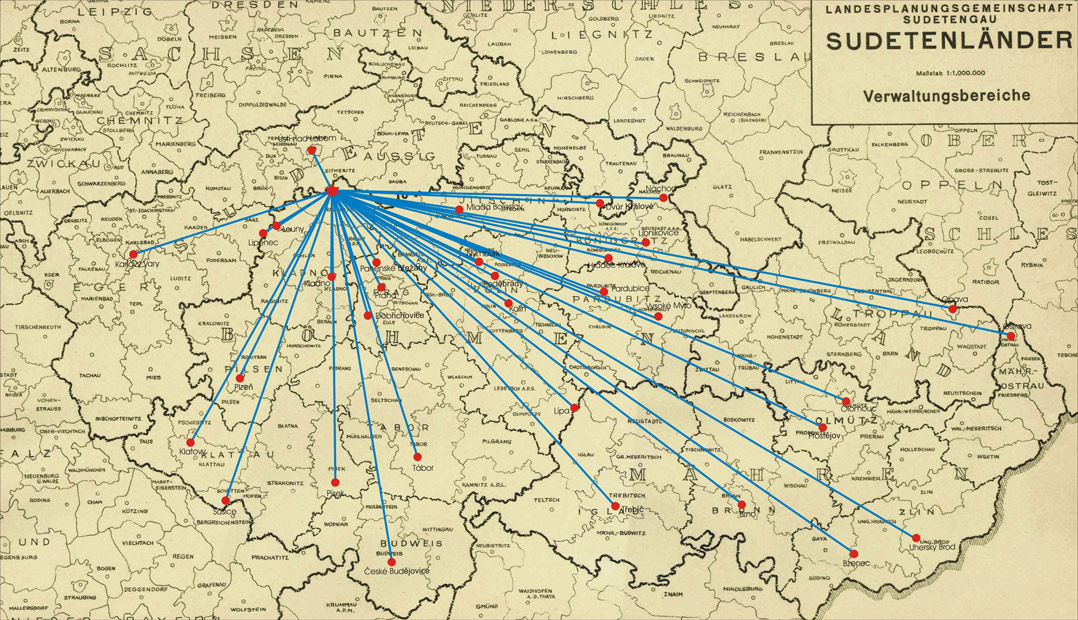 Fed by so many bleak tributaries, Terezín's misery became denser and denser, finally collapsing into a singularity of desolation. The inhabitants of the ghetto were crammed into attics and cellars, given next to no food, made to work 18 hours a day in freezing conditions, and beaten mercilessly. After only a few days, a majority of the population became severely diarrhetic. Next to no latrines or hygienic facilities were available in the ghetto, which soon became miry with waste and death.

During the first few days, death rates were low enough that bodies could still be buried, and funerals performed. However, as death rates climbed exponentially (literally), this quickly became impossible. The Nazis began work on a four-oven crematorium, which was completed in the fall of 1942. It ran continuously until the end of the war. Over 33,000 people died in the ghetto itself, and another 88,000 were sent to find certain death in liquidation camps to the east.

In this turbid course of events, a young girl of nascent artistic talent was separated from her father, who was placed in a different section of the ghetto. Through a fortuitous contact, she managed to smuggle a picture to him. She had drawn a snowman. On the back, she had written that she loved him. A few days later, the drawing was smuggled back to her. Her father had written that he loved her and that she ought not to draw snowmen. Instead, he had written: draw what you see. So, she drew one of the jagged, raw scenes so common in the ghetto and smuggled it to her father. It was returned to her blank, along the news that he had been put on a train car to Auschwitz a few days prior. His last words to her had been "draw what you see." So, she did. From then until the end of the war, she drew hundreds of bleak, realistic, and indelibly beautiful pictures of everyday life in the ghetto. Today, this body of work paints perhaps the most vibrant portrait of the Terezín ghetto we have:

While she drew away the years, a teacher on the other side of the ghetto led his gaunt students to a large, stately willow tree near the crematorium. He told them that after WWI, it had taken over five years for the members of his family to reunite with one another, scattered as they were by the war. He made his charges promise that when this had ended, they would return to the willow and find one another. Those who survived kept that promise, and today the scarred trunk of the Meeting Tree still stands in Terezín, just behind the crematorium, where it is visited by the descendants of those who reunited beneath its arched branches.

Terezín was liberated May 9, 1945, by the Soviet Army. Today, it is once again a small town of about 3,100 inhabitants.

Wednesday, February 3, 2010
Day Seventeen, in Which Wagner's Heart Breaks
"Hey, Honza."
"What?"
"Can you translate something into German for me?"
"What?"
"'You're breaking my heart, Max.' It's for a comic I'm drawing about Max Weber and Richard Wagner."
"What?"
"It's sort of a star-crossed lovers thing."
"What?"
Four minutes earlier:
I have come to believe that the clubs, pubs, and schlubs of Prague convene in a terribly muculent cellar nestled somewhere in the uncountable twists of the Prague underground in order to gather the most absurd collection of music possible and canonize it as The Prague Playlist. The List seems to largely be ruled by a tenuous coalition government between Lady Gaga, tearful raver-dropouts, and the song Infinity.
At this juncture, you should probably listen this song on YouTube or something.
It is more the less the aural fluid in which all other sonic experiences are suspended. However, I have this weird tic that comes from reading about two thousand pages more Weber than anyone should. I hear the song's ubiquitous lyric 'infinity' as 'modernity.' I don't know what's wrong with me either. This makes me picture Max Weber (stage name: Darth Weber) pursuing a career in the production of club music. This also makes me picture the illustrious German composer Richard Wagner being almost as bothered by this as he was by Jewish people. Also, I imagine Weber and Wagner palling around in Germany, not inviting Nietzsche to hang out with them at the opera and stuff. So, I sketched a little 3-panel bit before I got bored of the idea:

"What?"
"Can you translate something into German for me?"
"What?"
"'You're breaking my heart, Max.' It's for a comic I'm drawing about Max Weber and Richard Wagner."
"What?"
"It's sort of a star-crossed lovers thing."
"What?"
Four minutes earlier:
I have come to believe that the clubs, pubs, and schlubs of Prague convene in a terribly muculent cellar nestled somewhere in the uncountable twists of the Prague underground in order to gather the most absurd collection of music possible and canonize it as The Prague Playlist. The List seems to largely be ruled by a tenuous coalition government between Lady Gaga, tearful raver-dropouts, and the song Infinity.
At this juncture, you should probably listen this song on YouTube or something.
It is more the less the aural fluid in which all other sonic experiences are suspended. However, I have this weird tic that comes from reading about two thousand pages more Weber than anyone should. I hear the song's ubiquitous lyric 'infinity' as 'modernity.' I don't know what's wrong with me either. This makes me picture Max Weber (stage name: Darth Weber) pursuing a career in the production of club music. This also makes me picture the illustrious German composer Richard Wagner being almost as bothered by this as he was by Jewish people. Also, I imagine Weber and Wagner palling around in Germany, not inviting Nietzsche to hang out with them at the opera and stuff. So, I sketched a little 3-panel bit before I got bored of the idea:

Subscribe to:
Posts (Atom)